How much hail damage to replace roof: 1 Inch Hail Rule
After the Storm: Your First Steps and What to Know
Deciding how much hail damage warrants a roof replacement comes down to three quantifiable thresholds: hail diameter, verified impact density, and the roof’s age/material. The fast, answer-first rule is simple: 1-inch (quarter-sized) hail plus 7–10 verifiable impacts in a 10×10 foot test square typically justifies a full replacement on standard asphalt shingles—especially on roofs 10+ years old. If you’re in Sugar Land, Missouri City, or Richmond, the most reliable way to know where you stand is to schedule a professional assessment from a trusted Houston-area roofer who documents damage the same way insurers do.
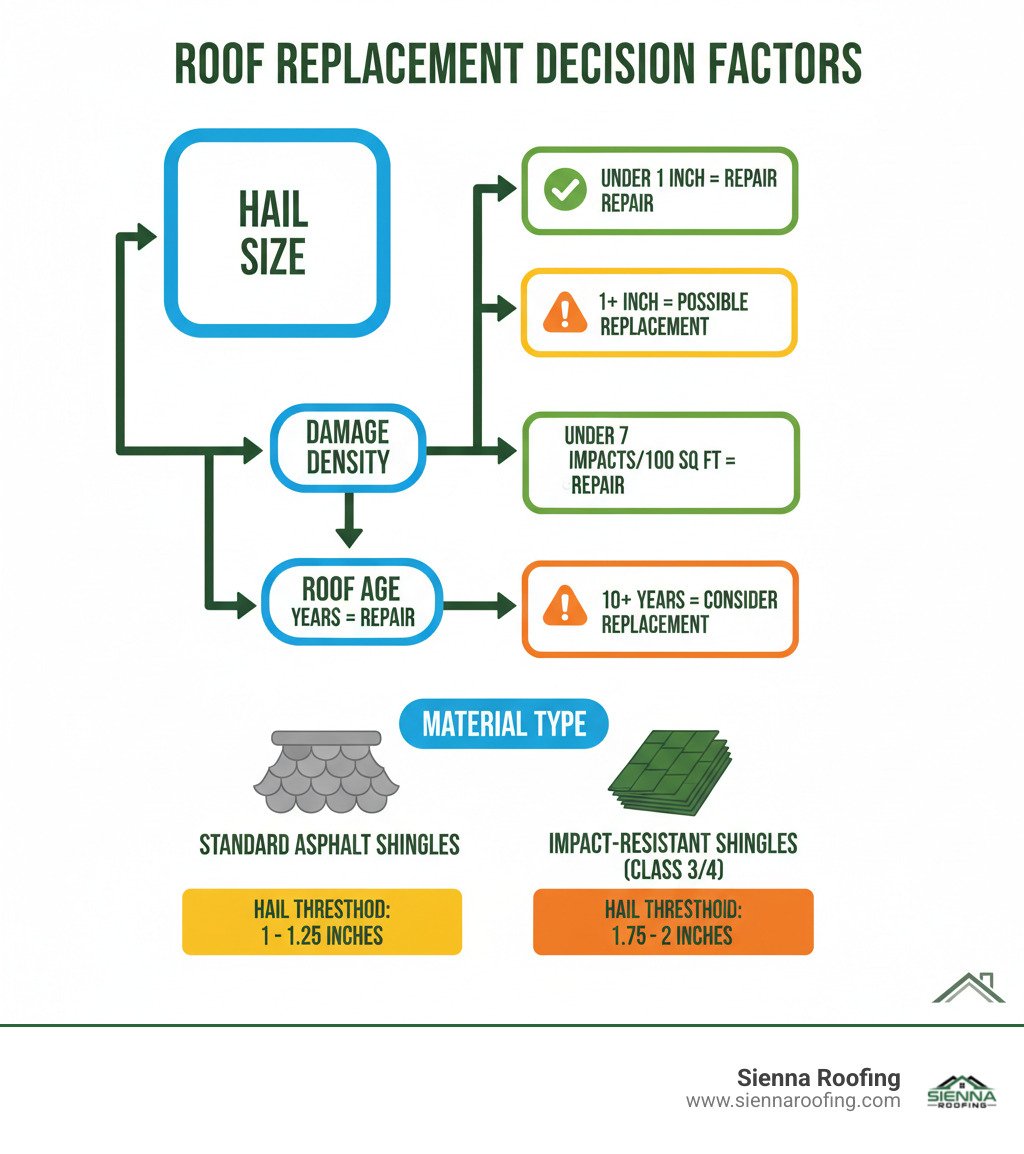
Deciding how much hail damage warrants a roof replacement depends on three key factors: hail size, damage density, and your roof’s age and material. A full replacement is typically triggered when these thresholds are met:
- Hail Size: Quarter-sized hail (1 inch) is the industry benchmark for causing functional damage to standard asphalt shingles, often justifying an insurance claim.
- Impact Density: Insurance adjusters generally approve a replacement when they identify 7-10 hail impacts within a 10×10 foot test square.
- Roof Age: Older roofs (10+ years) are more susceptible to severe hail damage and are more likely to require a full replacement over simple repairs.
- Material Type: Impact-resistant shingles (Class 3 or 4) can withstand larger hail, often up to 2 inches, before replacement is necessary.
After a hailstorm tears through Sugar Land or the Greater Houston area, many homeowners face a confusing question: Is my roof damaged enough to replace, or can I just repair it? The answer isn’t always obvious from the ground. After a storm, getting a professional assessment from a trusted Houston-area roofer is the most reliable way to determine the extent of the damage.
Hailstones can range from pea-sized pellets to softball-sized chunks. According to data from NOAA, severe storms cause billions of dollars in property damage annually, with thousands of severe hail reports across the U.S. each year. Even hail that seems “small” can compromise your roof’s integrity, leading to leaks, mold, and structural damage if left unaddressed.
The stakes are high. Waiting too long can turn a manageable insurance claim into an expensive out-of-pocket emergency. Acting too quickly without a proper assessment, however, might cause you to miss critical damage that worsens over time.
I’m Andre Castro, CEO of Sienna Roofing & Solar, and I’ve guided hundreds of Houston-area homeowners through the process of assessing how much hail damage to replace roof systems after severe storms. My team and I have worked with every major insurance carrier to ensure our clients get the coverage they deserve for storm-damaged roofs.
This guide will walk you through the exact criteria that determine whether your roof needs repair or replacement, what insurance adjusters look for during inspections, and how to protect your home’s value after a storm.
Find more about how much hail damage to replace roof:
Action plan for the first 48 hours after a storm:
- Document everything: take time-stamped photos of shingles, gutters, downspouts, siding, windows, and A/C fins.
- Check for granules: look in gutters, downspouts, and at the base of downspouts for piles of shingle granules.
- Mitigate active leaks: place buckets, move valuables, and consider temporary tarping if safe.
- Call a local pro: request a photo-logged inspection that follows insurer criteria (10×10 test squares, slope-by-slope).
- Avoid storm-chaser pressure: never sign contingency contracts on the spot; insist on clear scopes and local references.
Why quarter-sized hail matters: a 1-inch hailstone has over three times the volume of a 0.75-inch stone, and a 2-inch hailstone has eight times the volume of a 1-inch stone. Because mass scales with volume, larger stones deliver dramatically greater impact energy at similar speeds, which accelerates shingle mat fractures, granule loss, and premature aging.
Key pitfalls to avoid:
- Assuming “no leaks” means “no damage” — many hail impacts are latent defects that leak months later.
- Relying on curbside looks — damage assessment requires tactile checks for bruising and mat fractures.
- Filing without documentation — thorough, slope-specific photos significantly strengthen claims.
The “Magic Number”: What Size Hail Causes Significant Roof Damage?
Answer first: Quarter-sized hail (1 inch) is the decisive threshold for functional damage to standard asphalt shingles. At 1 inch, impacts commonly bruise the mat, dislodge protective granules, and shorten service life. Class 3–4 impact-resistant shingles raise that threshold to roughly 1.75–2 inches. Wind amplifies damage; 0.75-inch hail driven by 50+ mph winds can still cause system-wide harm when impacts are oblique and repetitive.
After a hailstorm passes through Sugar Land, the critical question is whether the hail was large enough to cause functional damage. The answer determines if you need a minor repair or a full roof replacement covered by insurance.
The definitive threshold for significant roof damage is hail that is 1 inch in diameter or larger—the size of a quarter. This is the industry’s “magic number.” At this size, hail has enough force to bruise standard asphalt shingles, cause substantial granule loss, and compromise the shingle’s ability to protect your home from UV rays and moisture.
However, not all roofs are created equal. Class 3 or Class 4 impact-resistant shingles provide superior protection. These specialized shingles can withstand hail up to 1.75 to 2 inches in diameter before sustaining functional damage. Their reinforced construction and modified asphalt absorb and disperse the energy from large hailstones, which is why many insurance carriers offer discounts for them. For technical background on impact testing and classifications, see the Insurance Institute for Business & Home Safety’s overview of impact-resistant roofing standards: https://ibhs.org/hail/impact-resistant-roofing/
Wind speed is a critical multiplier. Hail rarely falls straight down. Even ¾-inch hail can cause significant damage when driven by high winds (50+ mph). The sharp impact angles can dislodge granules, dent gutters, tear window screens, and chip paint, creating widespread collateral damage that strengthens an insurance claim. When hail reaches the 1-inch threshold, the damage becomes systemic, affecting shingles, siding, and metal fascia, which is when insurance adjusters begin to recommend a full replacement. For more insights, see our guide on Hail and Wind Damage to Roof.

The Adjuster’s Standard: The 10×10 Test Square
Insurance adjusters use a systematic, quantifiable method to assess hail damage, ensuring consistency and objectivity. The standard practice is to mark out a 10-foot by 10-foot square on each slope of the roof. This 100-square-foot test area acts as a representative sample of the roof’s overall condition.
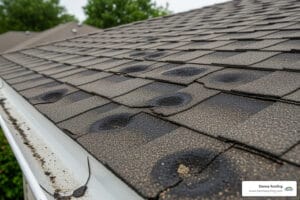
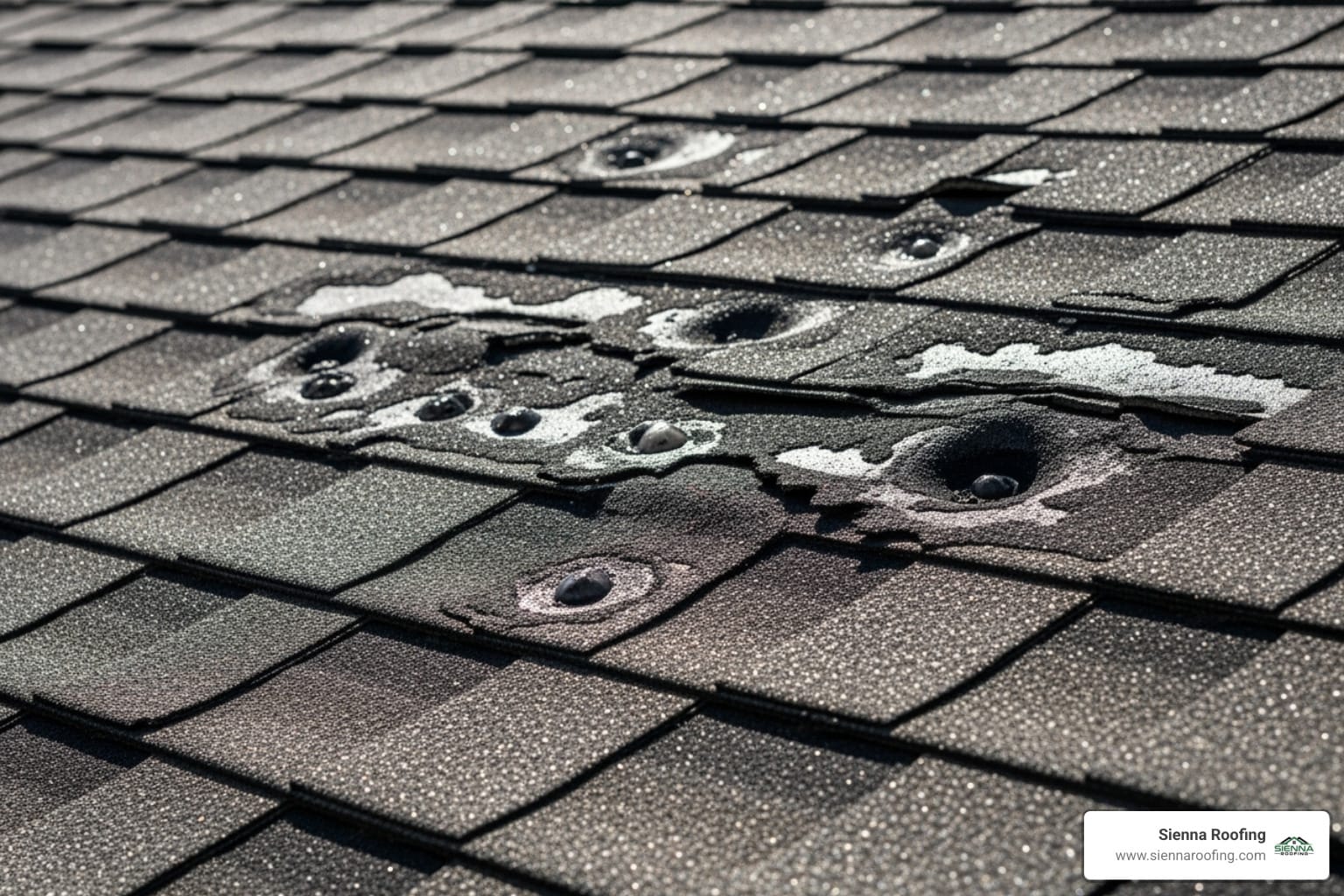
Within this square, the adjuster carefully counts every verifiable hail impact. They look for key indicators: circular indentations, missing granules exposing the asphalt, soft or bruised spots in the shingle mat, and fractures in the shingle.
An adjuster’s finding of 7-10 verifiable hail impacts within this 100-square-foot test area is the industry standard for approving a full roof replacement. This density of damage signifies that the roof’s integrity is compromised system-wide, making individual repairs impractical and ineffective. This objective data is crucial for determining how much hail damage to replace roof structures and is the foundation of a successful insurance claim. For a complete overview of the next steps, our full roof replacement guide details the entire process.
How the test plays out on real homes:
- Multiple slopes are sampled to capture directional exposure; storm tracks and prevailing winds often concentrate damage on specific elevations.
- Steeper or newer slopes can mask damage visually; tactile checks for soft bruises are essential.
- Collateral indicators (dented vents, downspouts, and A/C fins) corroborate the presence and intensity of hail across the property.
How Different Roofing Materials Stand Up to Hail
Your roof’s material is the primary factor in its ability to withstand hail. While no roof is completely hail-proof, some materials offer far superior protection.
-
Standard Asphalt Shingles: As the most common roofing material in the Houston area, asphalt shingles are affordable but also the most vulnerable to hail. They can sustain functional damage from 1-inch hail, leading to granule loss and mat bruising. Their primary advantage is that they are cost-effective to repair or replace.
-
Impact-Resistant Shingles: These Class 3 and Class 4 rated shingles are a significant upgrade. Their flexible, reinforced construction allows them to withstand impacts from hail up to 2 inches in diameter. The higher upfront cost is often offset by insurance premium discounts and long-term durability. Impact ratings are established through standardized steel-ball drop tests that simulate hailstone impacts on new products.
-
Metal Roofing: Metal is one of the most hail-resistant materials available. While large hailstones may cause cosmetic denting, they rarely puncture the material or compromise its waterproofing capabilities. Most metal roofs carry a Class 4 impact rating and can last 50 years or more.
-
Slate and Tile Roofs: These materials offer exceptional longevity but can be brittle. Large hail may crack or shatter individual tiles, which requires replacement to prevent water intrusion. While the roof structure is rarely compromised, repairs must be made promptly. Matching aged or discontinued tiles can sometimes be a challenge.
Documentation tip that strengthens claims: photograph 10×10 test squares, circle impacts with chalk, and include a scale reference (coin or tape measure) in each frame. Clear, slope-by-slope evidence shortens carrier review times and reduces reinspection requests.