Cost to Add Solar Panels 2025: Save Big!
Your Guide to the Cost to Add Solar Panels
The average cost to add solar panels for a typical U.S. home in 2025 ranges from $18,000 to $43,000. If you’re thinking about adding solar panels, understanding this cost is your first step. It’s a significant decision, but it’s also a smart investment that can save you money for years. As a leading roofing and solar company in the Houston area, we’ve seen how solar panels lead to energy independence and lower power bills. Over 25 years, a solar installation could save you anywhere from $37,000 to $148,000 on electricity.
Here’s a quick look at average costs for a standard 10 kW system:
- Before Incentives: Approximately $28,241
- After 30% Federal Tax Credit: Approximately $19,873
This guide will help you see the full picture. We’ll break down every expense, from the panels themselves to the permits. For homeowners in the Houston area, exploring sustainable solar solutions is a great way to start. Let’s look at what goes into the price tag.
As Andre Castro, CEO and founder of Sienna Roofing & Solar, I’ve seen the benefits and intricacies of the cost to add solar panels. My background in Construction Management and years of roofing experience give me a unique understanding of how these systems integrate with your home.

The Average Cost to Add Solar Panels in 2025: What to Expect in Texas
So, you’re wondering about the cost to add solar panels to your home. It’s a fantastic question, and honestly, there’s no single, one-size-fits-all answer. Think of it like buying a car – a compact sedan costs less than a luxury SUV, and the features you add change the price. But we can certainly give you a clear picture of what to expect!
Across the U.S., the average solar installation costs around $2.53 per watt before any incentives kick in. For a typical 10-kW system, that means you’re looking at about $28,241 before the federal tax credit. But here’s the exciting part: after applying that generous 30% federal incentive, the price drops to roughly $19,873. In Texas, we often see similar figures, with a 10 kW system averaging around $26,400 before the credit, falling to about $18,480 after. It might surprise you to learn that the solar panels themselves usually only make up about 18-20% of that total price.
Understanding Cost Per Watt ($/W): Your Solar Benchmark
When you start getting quotes, you’ll hear the term “cost per watt” ($/W) a lot. It’s super important! This is a standardized way to compare different solar systems and installers fairly. You just take the total cost of the system and divide it by its total wattage. For instance, if a 10,000-watt (or 10 kW) system costs $26,400, your cost per watt is $2.64. Simple, right?
In our beautiful state of Texas, the average cost per watt can vary. We often see figures around $2.64/W for a 10 kW system. But here’s a neat trick of the trade: thanks to something called “economies of scale,” bigger systems often have a lower cost per watt. So, a larger 12 kW system might bring that figure down to around $2.14/W. It means the more power you need, the more cost-effective each watt becomes!
System Size and Your Total Price: Matching Power to Your Needs
The size of your solar panel system, measured in kilowatts (kW), is a huge factor in your overall investment. To figure out the perfect size for your home in Sugar Land, Missouri City, Richmond, or anywhere in the greater Houston area, we look at your past electricity bills. We usually check your energy use over the last 12 months to get a clear picture of your average kilowatt-hour (kWh) consumption.
To give you a general idea, here’s how system size can impact the estimated cost to add solar panels (both before and after that fantastic federal tax credit):
| System Size (kW) | Estimated Cost Before Incentives | Estimated Cost After 30% Federal Tax Credit |
|---|---|---|
| 5 kW | $13,200 – $15,000 | $9,240 – $10,500 |
| 8 kW | $21,120 – $24,000 | $14,784 – $16,800 |
| 10 kW | $26,400 – $30,000 | $18,480 – $21,000 |
| 12 kW | $25,680 – $30,000 | $17,976 – $21,000 |
Note: These are estimates for the Texas market, reflecting typical ranges. Actual costs can vary based on specific equipment and installation complexities.
But we don’t just look at today’s energy use. We also chat about your future plans! Are you dreaming of an electric vehicle (EV) that will need charging at home? Maybe adding a new pool or other energy-hungry appliances? We factor all of this into your system design. This way, your solar setup will serve you well for years to come, ensuring you won’t outgrow your energy independence too quickly.
A Detailed Cost Breakdown: Where Does Your Money Go?
Understanding the cost to add solar panels means seeing all the pieces of the puzzle, not just the shiny panels. The total price is a mix of hardware (the physical parts) and “soft costs” (all the services and behind-the-scenes work).
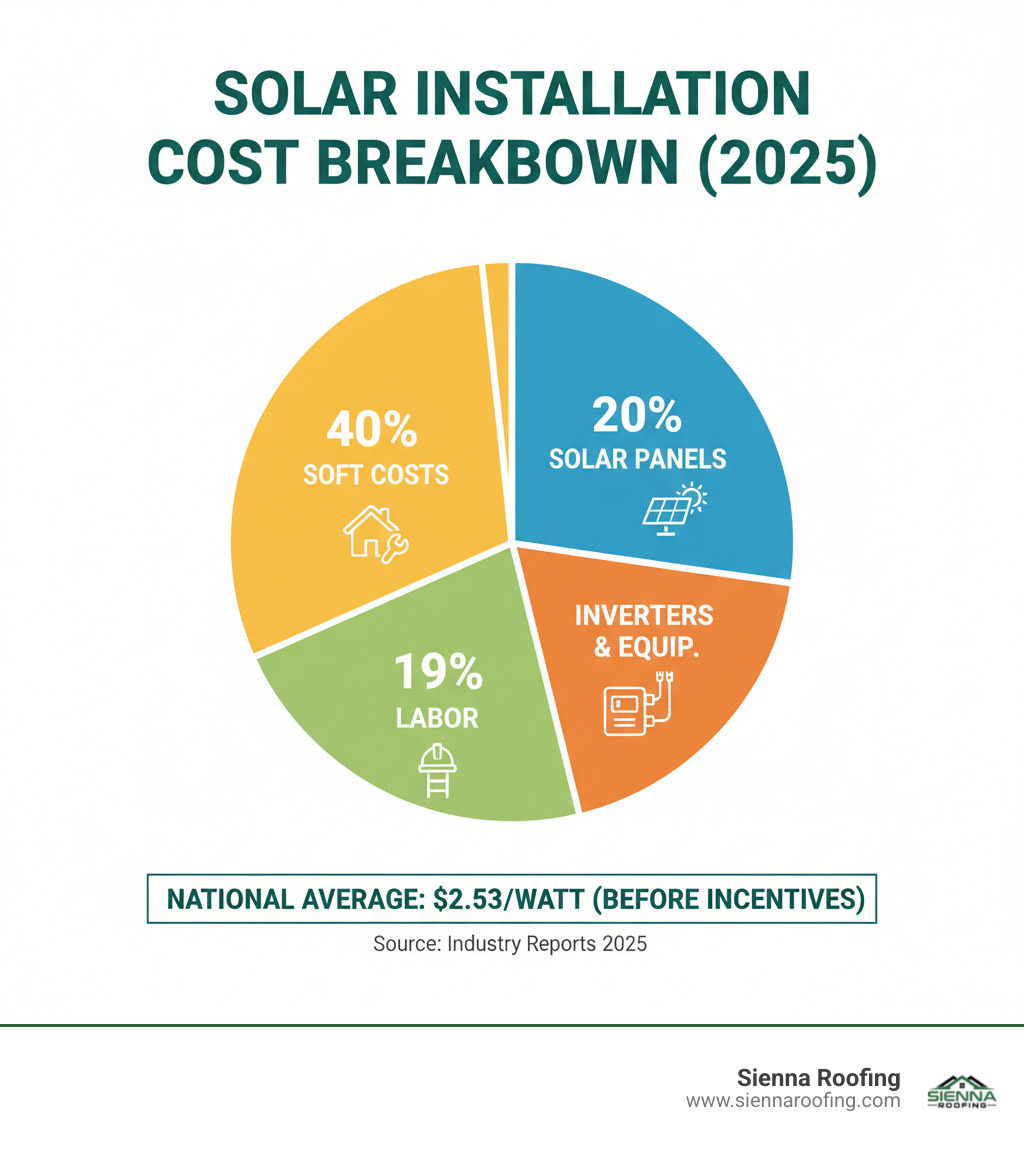
Here’s a typical breakdown of where your investment goes for a residential solar installation:
- Solar Panels (18%): These are the stars of the show – the modules that capture sunlight.
- Inverter and Other System Equipment (19%): This includes the crucial inverter (which turns the panels’ DC power into usable AC power for your home), plus all the racking, wiring, and other electrical bits and bobs.
- Installation Labor (11%): The skilled professionals who safely and efficiently install everything on your roof and connect it to your home’s electrical system.
- Permits and Inspections (5%): These are the fees for local permits, necessary inspections, and getting connected to your utility grid.
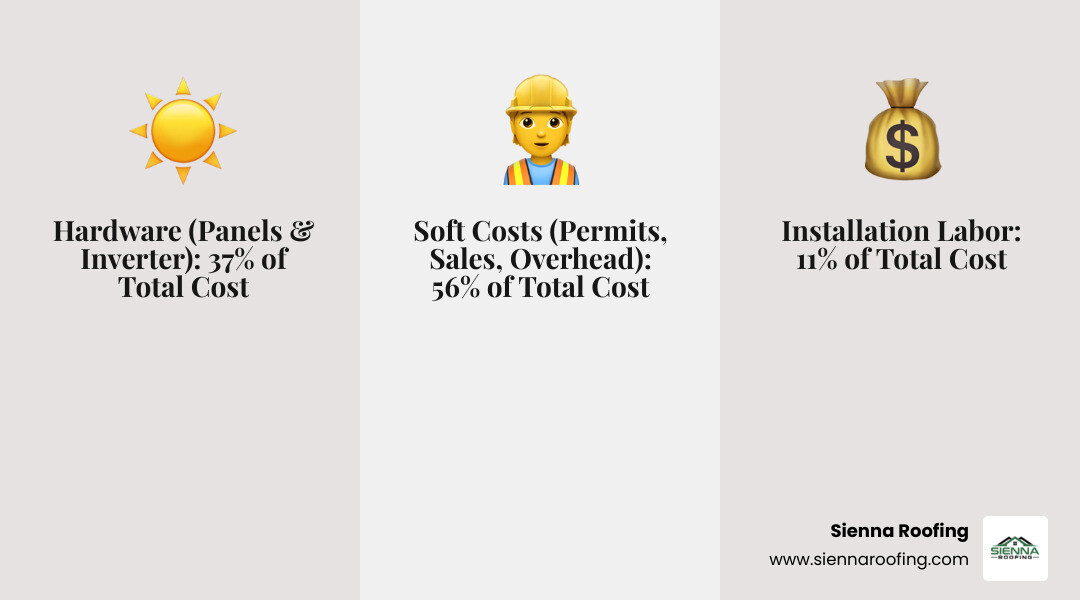
- Soft Costs (51%): This is the biggest slice! It covers everything else that makes a project happen smoothly: sales and marketing, company overhead, customer acquisition, detailed system design, and the installer’s profit.
As you can see, more than half of the total cost is tied up in the labor, permits, and other non-hardware essentials. While the panels are what you see, the intricate dance of design, professional installation, and navigating regulations truly makes up the bulk of your investment. It’s all about ensuring your system is safe, efficient, and perfectly suited for your home.
Key Factors That Influence Your Solar Installation Price: Beyond the Basics
Every home tells its own story, and when it comes to solar, your home’s unique features play a big part in the final price. These factors go beyond just the size of your system. Understanding them is key to getting an accurate estimate for the cost to add solar panels and avoiding any surprises along the way.
The Cost to Add Solar Panels Based on Equipment: Choosing Your Technology
The kind of equipment you pick makes a real difference in the overall cost to add solar panels. Think of it like choosing a car – different models come with different price tags and features.
First, let’s talk about solar panel types. You’ll mainly hear about three: Monocrystalline panels are the most efficient. This means they produce more power in a smaller space. They might cost a bit more, but they’re perfect if your roof isn’t huge or if you want the most energy possible. Their efficiency usually falls between 15% and 22%. Then there are Polycrystalline panels. These are a bit easier on the wallet and still do a great job. They’re a smart choice if you have plenty of roof space. You can expect their efficiency to be around 13% to 17%. Lastly, there are Thin-film panels. While they’re often the cheapest per watt, they’re also the least efficient (6% to 15%) and don’t last as long. They usually need a much larger area to generate the same amount of power, so they’re not as common for home rooftops.
Next up is inverter technology. This is what changes the sun’s power into electricity your home can use. String inverters are a more traditional and generally less expensive choice, usually costing between $1,000 and $3,000. They link a group of panels together. The downside? If one panel gets shaded, it can slow down the whole group. For more advanced options, consider Microinverters or Power Optimizers. These are usually pricier ($2,700–$10,200 for microinverters; $900–$6,800 for optimizers). But they work with each panel individually. This means if one panel is in the shade, the others keep working at their best. They’re a smart pick for roofs with tricky shapes or places where shading might be an issue.
Finally, you might consider battery storage add-ons. Adding a solar battery can increase the total cost to add solar panels by $7,000 to $18,000. But for many Houston homeowners, it’s worth every penny. A battery provides priceless backup power when the grid goes down – a common worry here. It also lets you save extra solar energy to use at night or when electricity rates are higher, giving you true energy independence.
Your Home’s Unique Characteristics: The Roof and Beyond
Your home itself has a big say in how much your solar project will cost. Every roof is different, and these details can add up.
Let’s start with your roof’s condition and material. Solar panels are built to last 25 to 30 years, so your roof needs to be in great shape to match. If your roof is old or damaged, we’ll likely suggest fixing or even replacing it first. Why? Because taking panels off and putting them back on later for roof repairs can cost an extra $1,000 to $3,000 or more! In a humid climate like Houston, putting off roof repairs can quickly lead to bigger problems like water damage and mold. It’s almost always cheaper to deal with roofing issues now rather than later. Materials matter too. Asphalt shingles are usually straightforward for installation. But if you have a metal or tile roof, we might need special mounts and techniques, which can slightly increase the cost.
The roof angle and orientation also play a role. A roof facing south is ideal because it gets the most sun all day long. But don’t worry if yours doesn’t! East or west-facing roofs can still be very effective, though they might need a few more panels to produce the same amount of energy. If your roof is steep, has many angles, dormers (those little windowed bumps), or chimneys, it’s considered “complex.” Complex roofs need more labor and special parts, adding to the installation time and the overall cost to add solar panels.
What about shading from trees? If big trees cast shadows over your roof, they’ll reduce how much power your panels can make. We might suggest trimming or even removing those trees, which can add $300 to $1,500 to your project.
And don’t forget your electrical panel. Many homes, especially older ones, might not have enough capacity to handle a new solar system. An upgrade to at least a 200-amp panel might be necessary, adding a few thousand dollars to your total investment. It’s a vital step to ensure your home can handle all that new, clean energy!
Installation, Permits, and Finding a Reliable Installer: The Human Element
Beyond the equipment and your home’s structure, the people and paperwork involved also contribute significantly to the cost to add solar panels.
Labor costs are a big part of the price. You’re paying for skilled professionals who know how to safely and efficiently install your system. These costs can change based on wages in your area and how complicated your specific project is. Then there are permitting fees. Before anyone lifts a finger, we need to get local permits and make sure everything follows the rules in Sugar Land, Missouri City, Richmond, or wherever you are in the Houston area. These fees can range from $100 to over $1,000, depending on your exact location. Finally, after installation, your new system needs to connect to the local power grid, and there are often interconnection fees for this process.
Choosing the right installer is probably one of the most important decisions you’ll make. A dependable company like Sienna Roofing ensures your system is designed correctly, installed safely, and meets all local regulations. This protects your investment for years to come. When you start looking for a solar partner, understanding the key factors to consider when hiring a solar contractor will help make sure your project is smooth and successful.
Slashing Your Bill: Incentives, Rebates, and Long-Term Savings
Here’s the good news: while the upfront cost to add solar panels might make you pause, you won’t be paying the full sticker price. Various financial incentives significantly reduce your initial investment, making solar far more accessible than many homeowners realize. These programs don’t just help you get started—they accelerate your return on investment, turning solar from a distant dream into a smart, achievable financial move.
The 30% Federal Solar Tax Credit (ITC): Your Biggest Savings Tool
The Federal Investment Tax Credit (ITC) is the most powerful incentive available to homeowners installing solar panels anywhere in the U.S., including right here in Texas. This isn’t a rebate or a discount—it’s a direct reduction in your federal tax liability. The ITC allows you to deduct 30% of the total cost to add solar panels from what you owe the IRS. That includes everything: the panels, the inverter, the installation labor, even the permits.
Let’s make this concrete. If your solar system costs $26,400, you’ll receive a $7,920 credit on your federal taxes. That brings your actual out-of-pocket cost down to $18,480. That’s a substantial difference, and it makes solar financially viable for thousands of families who might otherwise struggle with the upfront investment.
The ITC covers both equipment and installation costs, which means every dollar you invest in quality components and professional installation from a trusted local company counts toward your credit. To learn more about eligibility requirements and exactly how to claim this valuable credit, consult the official Homeowner’s Guide to the Federal Tax Credit for Solar Photovoltaics from the Department of Energy. One important note: this generous 30% credit is currently set to expire at the end of 2025 unless Congress renews it. That makes now an excellent time to move forward with your solar plans.
State & Local Incentives in Texas: Finding Hidden Opportunities Close to Home
While Texas doesn’t offer a statewide solar tax credit, that doesn’t mean you’re out of options. Many local utilities and municipalities in our service areas—Sugar Land, Missouri City, Richmond, and throughout the Houston region—offer their own programs to encourage solar adoption.
One of the most valuable local benefits is net metering. This policy allows you to send any excess electricity your solar panels generate back to the utility grid. In return, your utility company provides credits on your electricity bill. On sunny days when your panels produce more power than you’re using, those extra kilowatt-hours don’t go to waste—they offset your usage during evening hours or cloudy days. For many homeowners, net metering can reduce or even eliminate monthly electricity bills entirely.
Texas also offers a property tax exemption for solar installations. When you add solar panels to your home, the increased value they bring is exempt from property taxes. You get all the benefits of a more valuable home without paying higher taxes for that improvement. It’s one of those rare win-win situations.
Some local utility providers and municipalities also offer direct rebates or incentives for solar installations. These programs vary by location and can change over time, so it’s worth doing your homework. Homeowners can search for current local incentives and explore various solar programs on the comprehensive DSIRE database. It’s the most thorough resource available for finding what’s available in your specific zip code.
Calculating Your Payback Period and ROI: When Does Solar Start Making You Money?
The “payback period” is simply how long it takes for your energy savings to equal the initial cost to add solar panels. For homeowners in Texas, the typical payback period ranges from 5 to 15 years. A 10 kW system in our area typically pays for itself in about 9 years and 6 months. That might sound like a long time, but remember—solar panels last 25 to 30 years. Once your system has paid for itself, you’re essentially generating free electricity for the next 15 to 20 years.
The math is straightforward: divide your total system cost by your annual electricity savings, and you’ll see exactly when your investment breaks even. After that point, every kilowatt-hour your panels produce is money in your pocket.
Beyond the payback period, solar offers an impressive Return on Investment (ROI). Over 20 years, homeowners in Texas can expect to save around $83,838 on electricity costs. And that’s just the direct savings on your utility bills. Solar panels also increase your home’s value. Multiple studies confirm that homes with solar sell for an average of $15,000 more than comparable homes without panels. Some research even suggests a 4.1% increase in home value.
When you combine the federal tax credit, long-term electricity savings, increased home value, and protection against rising utility rates, solar becomes one of the smartest financial decisions a homeowner can make. It’s not just about going green—though that’s a wonderful benefit. It’s about taking control of your energy costs and building long-term wealth through your home.
Frequently Asked Questions about Solar Panel Costs: Your Questions Answered
We get a lot of questions about the cost to add solar panels and what it means for homeowners. After years of working with families across Sugar Land, Missouri City, Richmond, and the greater Houston area, we’ve noticed the same thoughtful questions come up again and again. Let’s address the most common ones.
How many solar panels does a typical house need?
The number of solar panels your home needs isn’t a one-size-fits-all answer. It depends on three key factors: your annual electricity usage (measured in kilowatt-hours, kWh), the amount of sunlight your roof receives, and the wattage of the panels you choose.
Here’s a practical example: An average American home consumes about 10,632 kWh per year. To offset this usage, a typical household in the Houston area might need a 7-9 kW solar system, which usually translates to 18 to 25 panels (assuming each panel produces 350-400 watts). However, we’ve seen homes that need fewer panels because they’re more energy-efficient, and others that need more because of larger square footage or electric vehicle charging needs.
That’s why we always perform a detailed energy audit to determine the precise number of panels required for your specific home. We’ll review your past 12 months of electricity bills, assess your roof’s sun exposure, and factor in any future energy needs you’re planning.
Do solar panels increase my home’s value?
Absolutely! This is one of the most financially compelling reasons to invest in solar. Multiple studies confirm that homes with solar panels consistently sell for more than comparable homes without them.
A significant study by the U.S. Department of Energy’s Lawrence Berkeley National Laboratory, detailed in their Selling Into the Sun report, found that solar panels add an average of $15,000 to a home’s value. Other research indicates an increase of 4.1% in home value. This means that not only do you save on electricity bills month after month, but your investment also improves your property’s market appeal and resale price.
In the competitive Houston real estate market, having solar panels can be a major selling point. Potential buyers recognize the long-term value of reduced energy costs, especially as electricity rates continue to climb.
Can a house run entirely on solar power?
Yes, a house can run entirely on solar power, achieving true energy independence. To do so, you’d need an appropriately sized solar system designed to meet 100% of your household’s energy needs. This is completely achievable with proper planning and the right equipment.
For complete self-sufficiency, especially during nighttime hours or extended periods of cloudy weather, the system should be paired with a battery storage system. A battery allows you to store excess energy generated during sunny days for use when the sun isn’t shining or during power outages. This can be particularly beneficial during hurricane season in our region, when grid power might be unavailable for days.
We’ve helped many Houston-area homeowners design systems that cover their entire energy footprint, and they report incredible peace of mind knowing they’re protected from both rising electricity rates and unexpected outages.
Your Next Step Toward Energy Independence
You’ve learned the details. You’ve seen the numbers. Now it’s time to take action.
Investing in solar is a powerful way to take control of your energy costs, reduce your carbon footprint, and increase your property value. While the initial cost to add solar panels requires careful consideration, the combination of federal incentives and long-term savings makes it a financially sound decision for many Texas homeowners. Over the next 25 years, you’re not just installing panels – you’re investing in decades of energy savings and independence.
Working with a trusted local expert ensures your system is designed for maximum efficiency and longevity. A qualified installer will account for your home’s unique characteristics, your energy needs, and the specific challenges of the Houston climate. They’ll handle the permits, coordinate the inspections, and ensure your system is properly connected to the grid. Most importantly, they’ll be there if you need support down the road.
For homeowners in Sugar Land, Missouri City, Richmond, and the greater Houston area, the team at Sienna Roofing provides expert guidance and professional installation. We understand the local building codes, the weather patterns, and the specific needs of homeowners in our community. Our commitment to personalized service means you’re not just another project number – you’re a neighbor we’re helping achieve energy independence.
Ready to see what solar can do for your home? To get a personalized assessment and quote custom to your specific property, explore our sustainable solar solutions today. We’ll walk you through every step, from initial consultation to system activation, ensuring you feel confident about your investment. The sun is shining – let’s put it to work for you.