Hail storm roof damage: The #1 Expert Guide
Hail Storm Roof Damage: Fast ID Guide for Texas Homes
Hail storm roof damage is a major and frequent concern for homeowners, particularly in Texas, a state at the heart of what meteorologists call “Hailstorm Alley.” Hail causes an estimated $1 billion in property damage across the United States each year, and a significant portion of that occurs right here. With Texas averaging 195 severe weather days annually, the risk to your home’s primary shield—the roof—is exceptionally high. After a storm passes, the silence can be unsettling, leaving many homeowners wondering if their roof has been compromised. The financial and emotional stress of potential damage is immense, but knowledge is your first line of defense.
Knowing how to identify potential damage is crucial for protecting your home’s value, structural integrity, and the safety of your family. Even seemingly minor impacts can breach your roof’s protective layers, creating pathways for water intrusion that can lead to costly secondary issues like wood rot, damaged insulation, and mold growth. For homeowners seeking a trusted partner to navigate the post-storm process, Sienna Roofing—a trusted Houston roofing company—provides expert assessments and high-quality, durable solutions throughout the Houston area.
Key signs of hail storm roof damage to look for from the ground include:
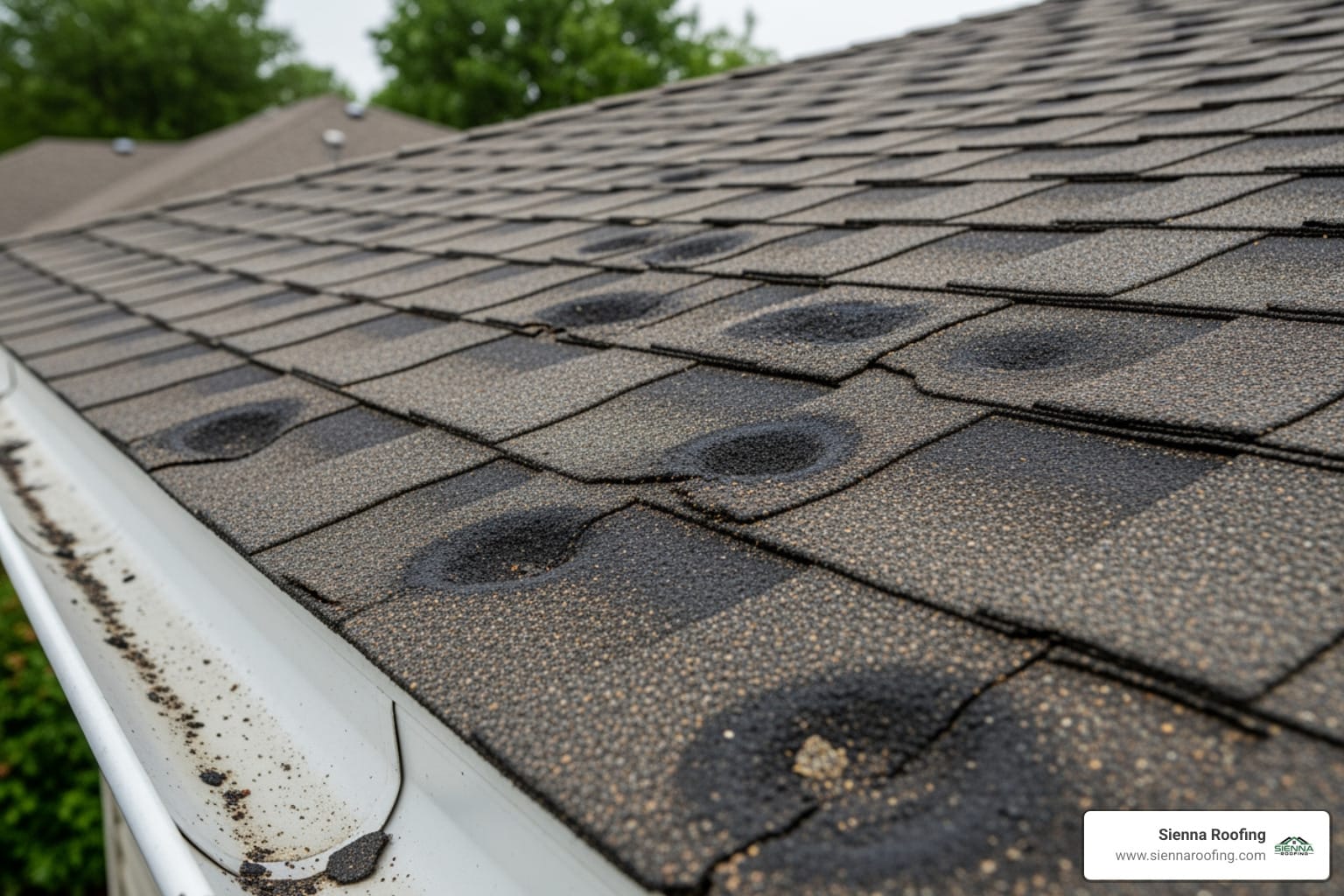
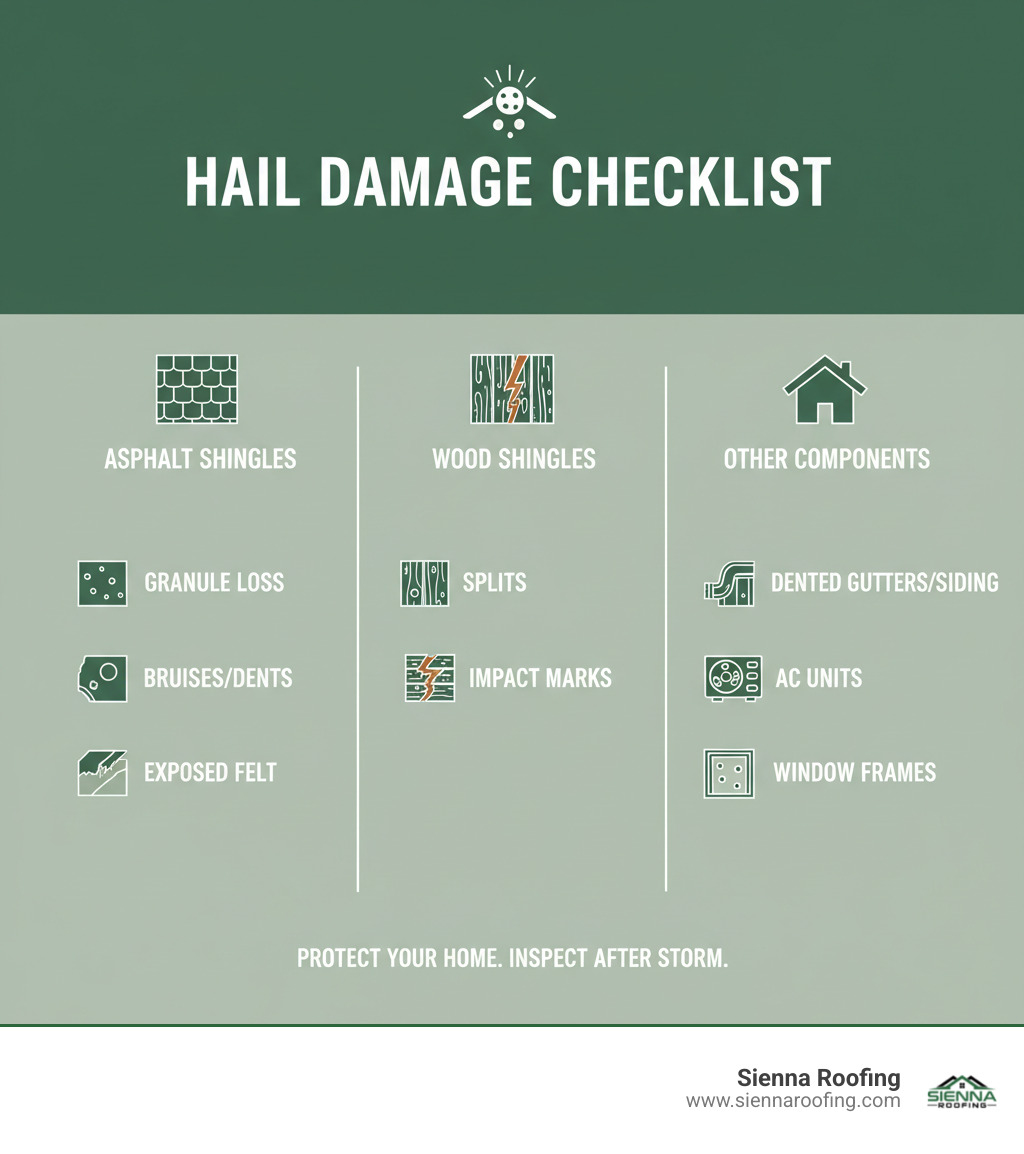
- Asphalt Shingles: Look for dented or “bruised” spots that may appear dark and shiny, significant granule loss that exposes the underlying dark asphalt, and any shingles that are cracked, broken, or missing.
- Wood Shingles: Check for splits that appear fresh, with sharp, brown or orange edges, and visible impact marks or dents in the wood.
- Other Areas: Inspect for dents in metal components like gutters, downspouts, siding, window frames, or the fins of your outdoor AC unit. These are often the most obvious indicators of a significant hailstorm.
For a complete overview of storm-related issues, see our Houston Storm Damage Ultimate Guide. This comprehensive guide will walk you through every step of detecting and addressing hail storm roof damage, from the initial inspection to successfully navigating your insurance claim.
How to Identify Hail Storm Roof Damage: A Homeowner’s Checklist
After a hailstorm, the severity of hail storm roof damage depends on a complex interplay of factors. It’s not just about the size of the hailstones. The density and shape of the hail (smooth vs. jagged), the wind speed and direction during the storm, and your roof’s age and material all play a critical role. A roof over 10 years old is significantly more vulnerable as its materials have already been weakened by years of sun and weather exposure. Understanding these variables helps you know what to look for and assess the potential risk. For expert help identifying and documenting damage, Sienna Roofing provides thorough, no-obligation inspections throughout the Houston area.
Signs on Asphalt & Composition Shingles
Asphalt shingles, the most common roofing material in our area, show distinct signs of hail damage. Unlike wind damage, which is often linear and directional, hail impacts create a random, scattered pattern across the roof’s surface. Here’s a more detailed look at what to spot:
- Bruising: This is the most critical sign of functional damage. A hail impact can fracture the fiberglass matting within the shingle. From the surface, it may look like a dark spot or a dent, but if you were to press on it (which should only be done by a professional), it would feel soft and spongy, like a bruise on an apple. This weakness is a prime entry point for water.
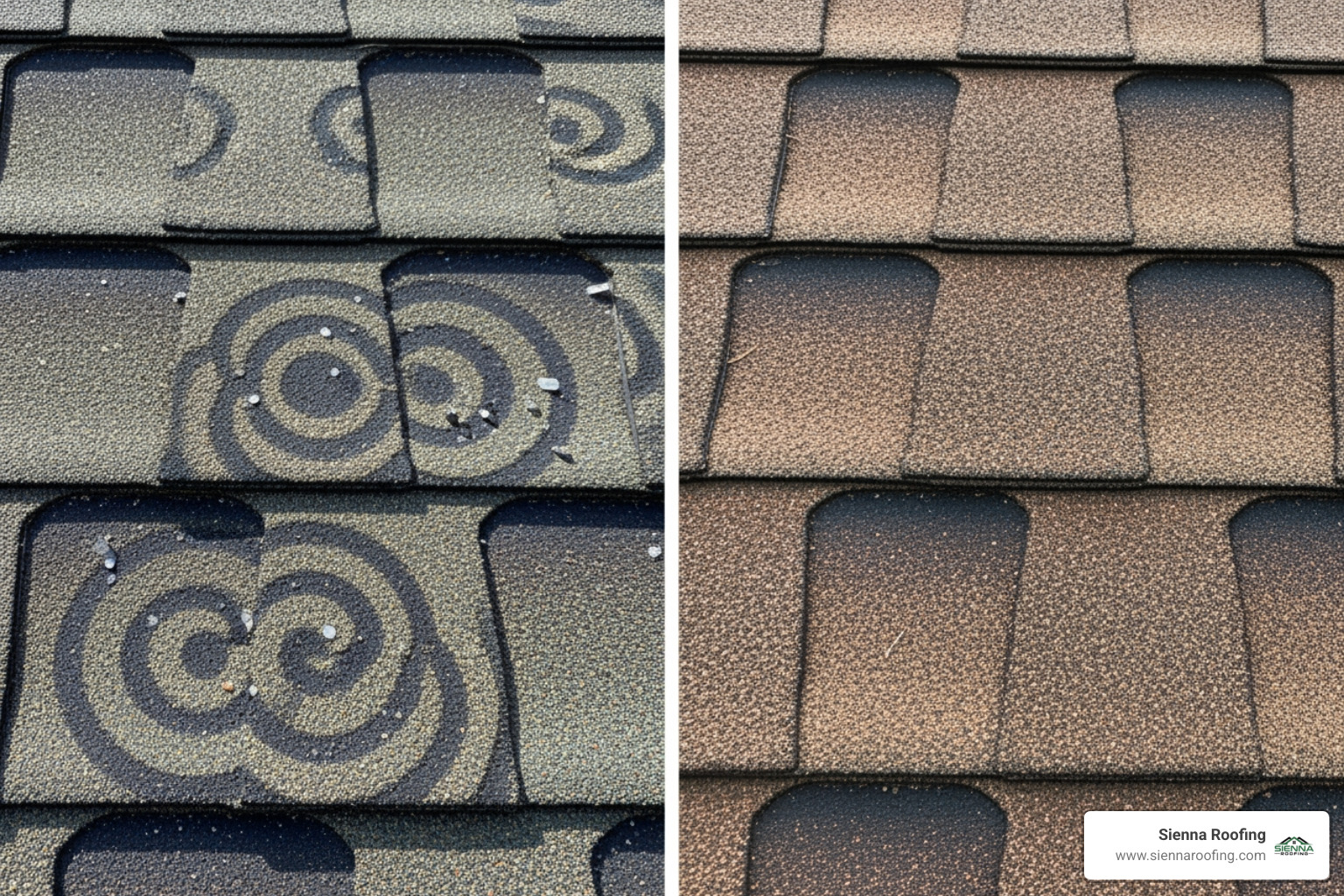
- Granule Loss: The ceramic-coated granules are the shingle’s first line of defense against UV rays and weather. Hail acts like a hammer, knocking these granules loose at the point of impact. You’ll see shiny, dark, or black spots on the shingle surface where the underlying asphalt is now exposed. This exposed asphalt will rapidly deteriorate under the Texas sun, drastically shortening the shingle’s lifespan.
- Exposed Felt or Matting: In cases of severe impact from large hailstones or on an older, brittle roof, the hail can puncture the shingle entirely. This may leave the underlying felt paper or fiberglass mat visible. This is a critical breach that leaves your roof deck immediately vulnerable to water infiltration and requires urgent attention.
If you notice these signs, especially widespread bruising or granule loss, your roof has likely sustained significant functional damage. Learn more about identifying hail damaged shingles.
What Size Hail Causes Noticeable Damage?
Hail does not need to be baseball-sized to cause serious, claim-worthy damage. The threshold for noticeable damage to asphalt shingles is typically 1 inch in diameter (quarter-sized), as this size carries enough force to bruise the shingle mat. However, other factors like wind speed can make smaller hail more destructive.
- ½ to ¾-inch (Marble to Penny-sized): Generally considered cosmetic, but when driven by high winds, it can cause significant granule loss, effectively aging your roof prematurely. It can also damage softer materials like vinyl siding and window screens.
- 1 to 1½-inch (Quarter to Half-dollar-sized): This is the range where functional damage becomes widespread. You’ll see obvious bruising, granule loss, and impacts on most roofing components.
- 1¾ to 2-inch (Golf ball-sized): This size hail causes severe damage. It can penetrate softer roof components, crack vinyl siding, and shatter weaker windows. A roof hit by hail this size will almost certainly need a full replacement.
- Over 2 inches (Tennis ball-sized and larger): This causes catastrophic damage, often punching holes directly through shingles and roof decking. A full roof replacement is almost always required, along with repairs to siding, windows, and other property.
Telltale Signs on Other Parts of Your House
Often, the easiest and safest way to confirm a hailstorm’s intensity is to check other parts of your property from the ground. This collateral damage serves as an undeniable early warning system for your roof.
- Gutters, Downspouts, and Roof Vents: These lightweight metal components are a hail damage magnet. Look for dents, dings, and dimples. If your gutters are dented, your shingles have almost certainly been impacted.
- Siding and Window Frames: Check for cracks, chips, or holes in vinyl siding and dents or chipped paint on wood or metal window frames and sills.
- Window Screens and Glazing: Torn or punctured window screens are a clear sign. Also, check the vinyl glazing strips around windowpanes for small cuts or marks.
- Air Conditioning Unit: The thin aluminum fins on your outdoor AC condenser are very delicate. Bent or flattened fins are a classic sign of hail and can impede your unit’s efficiency.
- Mailbox, Fences, or Deck: Check for dents on a metal mailbox or chipped paint or stain on your deck or fence. These surfaces will show impacts clearly.
- Vehicles: If your car was left outside and has dents, your roof almost certainly does too. This is often the most compelling evidence for an insurance adjuster.
Seeing damage on these items is a strong indicator that you need a professional roof inspection. Don’t wait for a leak to appear in your ceiling; by then, the damage is already advanced and more expensive to fix. Learn more about how to tell if your roof needs repair.
Is It Hail or Something Else? Differentiating Damage Types
Distinguishing hail storm roof damage from other common issues like blistering, algae growth, or normal wear and tear is critical for a successful insurance claim. Insurance adjusters are trained to spot these differences, and misidentifying the cause of your roof’s condition can lead to a swift claim denial. At Sienna Roofing, we specialize in this diagnostic process, helping homeowners in Sugar Land, Missouri City, and Richmond understand exactly what they’re seeing on their roofs and whether it constitutes a valid claim.
Common Types of Damage Mistaken for Hail
Your roof endures constant stress from the intense Texas climate, which can cause deterioration that mimics hail damage. It’s important to be aware of these common culprits to avoid filing an unnecessary or incorrect claim:
- Normal Wear and Tear: As a roof ages, it experiences gradual, uniform granule loss across its entire surface. The shingles may become brittle and develop small, hairline cracks. This looks very different from the random, circular impact points of hail.
- Sun Damage (Blistering): Intense UV exposure can cause the asphalt in shingles to heat up, creating small bubbles or blisters on the surface. These are often caused by trapped moisture within the shingle. A key differentiator is that blisters are raised and hollow; if you pop one, you won’t find a dent or impact mark underneath. Hail hits, in contrast, are depressions.
- Manufacturing Defects: Occasionally, shingles have flaws from the factory. This can manifest as uniform blistering or patterns of granule loss that repeat from shingle to shingle in a non-random way. A professional roofer can spot these patterns, which are typically covered by a manufacturer’s warranty, not homeowner’s insurance.
- Algae or Moss Growth: Dark, discolored streaks or patches, especially on shaded or north-facing slopes, are usually caused by algae (like Gloeocapsa magma). While unsightly, this is a cosmetic issue, not functional damage. It can be mistaken for the dark spots of granule loss, but algae sits on top of the granules, whereas hail damage removes them.
- Foot Traffic Damage: Careless walking on a roof, especially on a hot day, can scuff granules off in a pattern that follows a path to a chimney, satellite dish, or skylight. This damage is localized to specific pathways and looks different from the random pattern of a hailstorm.
Hail Damage vs. Wind Damage
Hail and wind often occur in the same storm, but they leave very different signatures on your roof. Correctly identifying the primary cause of damage is essential for your insurance claim, as some policies have different deductibles for wind and hail.
Hail Damage:
- Pattern: Creates a random, scattered pattern of circular impacts or dents.
- Effect: Causes bruising, fractures, and concentrated spots of granule loss at the point of impact. It is an “additive” damage, creating dents and marks.
- Location: Can be found anywhere on the roof slope, though it may be concentrated on the side that faced the storm.
Wind Damage:
- Pattern: Creates a linear or directional pattern, often affecting shingles in a distinct line or patch.
- Effect: Lifts, creases, tears, or completely removes entire shingles. The shingle’s sealant strip is broken. This is “subtractive” damage, as material is removed or displaced.
- Location: Often concentrated along the most vulnerable areas of the roof: the edges (rakes), the peak (ridge), and corners.
For a comprehensive comparison and visual examples, visit our page on Hail and Wind Damage to Roof. A professional assessment from an experienced roofer is always the best way to determine the true cause and extent of damage before contacting your insurance company.
The Aftermath: Your Step-by-Step Action Plan
After a hailstorm, the sight of your yard littered with leaves and hailstones can be overwhelming. Having a clear, methodical plan can turn stress into productive action. Follow these steps to secure your property, document the damage, and begin the recovery process efficiently.
Step 1: Perform a Safe, Ground-Level Inspection
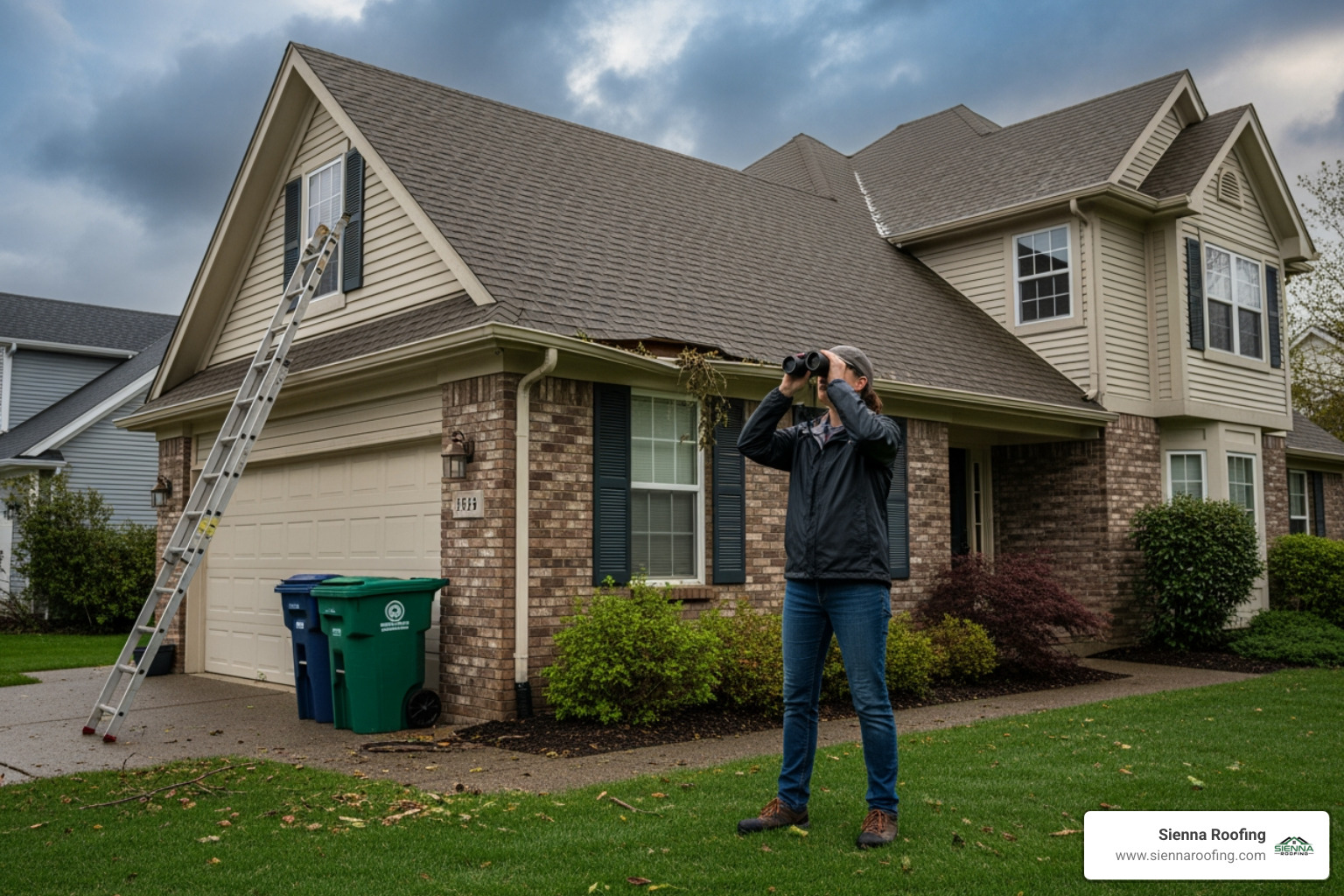
Your safety is the absolute top priority. Never get on your roof after a storm, especially when it may be wet, slippery, or structurally compromised. Instead, conduct a thorough inspection of your property from the ground. Before you begin, look for immediate hazards like downed power lines, broken glass from windows, or unstable tree limbs. Once the area is safe, walk the perimeter of your home. Use binoculars or your phone’s camera zoom to get a closer look at your roof. Look for obviously missing or crooked shingles, visible dents, or large areas of discoloration that indicate significant granule loss. A crucial step is to check your gutters and the areas around your downspouts. An accumulation of shingle granules (they look like coarse black sand) is a strong sign of widespread impact damage. Also, check skylights for any cracks or fractures. For more detailed guidance, see our page on how to tell if your roof needs repair.
Step 2: Document Everything Carefully
Thorough documentation is the foundation of a successful insurance claim. Before you move or clean up anything, take numerous photos and videos of your entire property. Capture both wide shots of each side of your house and close-ups of any specific damage you find. For close-ups of hail impacts on siding, gutters, or AC units, place a coin, ruler, or tape measure next to the impact. This provides a clear sense of scale for the insurance adjuster, which is critical for validating the severity of the storm. Create a simple “damage inventory” list, noting each damaged item and its location. Be sure to note the date and time of the storm and the approximate hail size you observed. Finally, keep all receipts for any temporary emergency repairs you must make, such as placing a tarp over a hole. These costs are often reimbursable under your policy.
Step 3: Schedule a Professional Roof Damage Assessment
Next, contact a reputable, local roofing contractor. An experienced roofer can provide an honest, expert assessment of whether the damage is severe enough to warrant an insurance claim, protecting you from filing unnecessarily (which can sometimes be noted on your record). They can safely access your roof to identify and document all damage, including subtle bruising and issues with flashing or vents that are invisible from the ground. This is the time to be wary of “storm chasers”—out-of-town contractors who flood an area after a storm. Red flags include high-pressure sales tactics, demands for large upfront payments, and a lack of a permanent local address or phone number. Always research a company’s reviews, local credentials, and ask for proof of insurance. A professional inspection from a trusted local company like Sienna Roofing provides a detailed report and estimate, which is an invaluable tool for your claim.
Step 4: File Your Insurance Claim Promptly
With your personal documentation and a professional assessment in hand, it’s time to contact your insurance company to initiate a claim. Most insurance policies have a time limit for filing, which in Texas is often one year from the date of the storm, but you should never wait that long. The longer you delay, the more difficult it can be to prove the damage was caused by that specific storm and not by subsequent events or general wear. Insurers may argue that waiting has allowed the damage to worsen. Filing promptly ensures that the hail storm roof damage is properly attributed to the covered event and that your claim is processed smoothly and fairly under your policy.
Navigating the Insurance Maze: From Claim to Repair
The insurance process can feel like a maze of unfamiliar terms and procedures. However, understanding a few key concepts and the roles of the people involved empowers you as a homeowner to navigate your hail storm roof damage claim with confidence and achieve a fair outcome.
Understanding Your Policy: ACV vs. RCV Explained
Your policy’s coverage type—Actual Cash Value (ACV) or Replacement Cost Value (RCV)—is the single most important factor determining your out-of-pocket costs for a roof replacement. It’s crucial to know which one you have.
Actual Cash Value (ACV) pays for the depreciated value of your roof. Insurance companies calculate this by taking the replacement cost and subtracting value for age and wear. If your 10-year-old roof is damaged, an ACV policy only pays for its current, worn-down value, leaving you to cover the significant difference for a brand-new roof.
Replacement Cost Value (RCV) is the preferred coverage. It covers the full cost to replace your roof with new, similar-quality materials, without deducting for depreciation. With an RCV policy, you are typically only responsible for paying your deductible.
Here’s a practical example: Imagine a full roof replacement costs $20,000 and your deductible is $2,000. Your roof is 10 years old with a 20-year expected lifespan (50% depreciated).
- With an RCV policy: The insurance company covers the full $20,000. You pay your $2,000 deductible, and the insurer pays the remaining $18,000.
- With an ACV policy: The insurance company first calculates the depreciated value: $20,000 – 50% depreciation = $10,000. They then subtract your deductible. You receive $8,000. You are now responsible for the remaining $12,000 to get your new roof.
| Feature | Actual Cash Value (ACV) | Replacement Cost Value (RCV) |
|---|---|---|
| Definition | Pays for the depreciated value of your roof. | Pays the cost to replace your roof with new materials. |
| Payout Structure | One payment, minus your deductible, based on age and wear. | Often two payments: initial ACV, then remaining RCV after work is complete. |
| Out-of-Pocket | You cover the depreciation difference. Can be substantial. | You cover only your deductible (and any upgrades). |
| Cost | Lower premiums. | Higher premiums. |
The Role of Your Roofing Contractor in the Claim Process
A reputable roofing contractor is your most important advocate during the insurance claim process. They are not just there to perform the repair; they are your technical expert. At Sienna Roofing, we:
- Provide a detailed, line-item estimate using industry-standard software like Xactimate. This software is used by most insurance carriers, ensuring our estimate speaks the same language as the adjuster’s. It itemizes every single component, from the shingles down to the specific type of flashing and number of nails, preventing items from being overlooked.
- Meet with the insurance adjuster on-site to walk the roof together. This is a critical step. We can point out damage the adjuster might miss, explain the difference between hail impacts and other conditions, and ensure a comprehensive assessment is performed.
- Advocate for a fair and complete scope of work. If an adjuster’s initial estimate misses key components required by local building codes or necessary for a proper installation (like ice and water shield, starter strips, or proper ventilation), we push back with documentation and evidence to ensure your roof is fully restored to pre-storm condition or better, according to your policy.
How much hail damage to replace a roof?
To justify a full roof replacement, insurance adjusters are trained to look for a specific density of hail storm roof damage. The widely accepted industry standard is generally 8 to 10 qualifying hail impacts within a 10×10 foot square (100 sq ft) area, known as a “test square.” Furthermore, they typically need to find this density of damage on multiple slopes of the roof to confirm the damage is widespread and not isolated. A “qualifying hit” is one that has functionally damaged the shingle by causing bruising (mat fracture) or significant granule loss, not just a cosmetic surface scuff. Because this threshold can be subjective and vary between adjusters, having a professional roofer present during the inspection is crucial to ensure all valid impacts are counted. Learn more about How Much Hail Damage to Replace Roof.
The Cost of Waiting: Hidden Risks and How to Hail-Proof Your Roof
After a storm, it can be tempting to ignore what seems like minor hail storm roof damage, especially if there are no active leaks. However, this delay can be a costly mistake, allowing a small, manageable problem to quietly escalate into a catastrophic failure. Protecting your home means addressing damage promptly to prevent a domino effect of expensive problems over time.
The Hidden Dangers of Ignoring Hail Storm Roof Damage
A roof does not need to be actively leaking to be severely compromised. The granules on your shingles are like sunscreen for your roof; once they’re gone, the underlying asphalt is exposed and deteriorates rapidly. The hidden dangers of unaddressed hail damage include:
- Drastically Shortened Roof Lifespan: Hail impacts displace the protective granules, exposing the asphalt mat to harsh UV rays. This causes the asphalt to become brittle and crack, accelerating the aging process. A roof that should last 20-25 years might begin to fail in as little as 5-10 years after a significant hailstorm.
- Slow Water Infiltration: A bruised or cracked shingle may not leak immediately. Instead, it can allow small amounts of water to seep in with each rain. This moisture gets trapped in the underlayment and roof decking, leading to slow, silent wood rot. By the time you see a stain on your ceiling, the structural damage is often extensive.
- Mold and Mildew Growth: That slow, hidden leak creates the perfect dark, damp environment in your attic for mold and mildew to thrive. Mold can destroy insulation and structural wood, and its spores can enter your home’s HVAC system, posing a serious health hazard to your family that requires expensive professional remediation.
- Voided Manufacturer Warranties: Nearly all shingle manufacturers’ warranties are voided if storm damage is not identified and repaired in a timely manner. By waiting, you risk losing this valuable protection for the future.
What starts as a simple insurance claim for a roof repair can spiral into a massive project involving structural repairs, mold remediation, and interior finishing if ignored. To understand the potential financial impact, Learn about repair costs.
Are Some Roofing Materials More Hail-Resistant?
Yes. When replacing a storm-damaged roof, especially in a hail-prone area like Houston, upgrading to a more resilient material is a smart long-term investment. Options include:
- Impact-Resistant (Class 4) Shingles: These are the top-tier asphalt shingles. They are engineered with a rubberizing polymer (like SBS-modified asphalt) that allows them to absorb impacts more effectively. They are certified through the UL 2218 test, where a 2-inch steel ball is dropped from 20 feet without causing the shingle to crack or rupture. Many insurance companies offer significant annual premium discounts for installing a Class 4 roof, as detailed by the IBHS hail impact ratings.
- Metal Roofing: Standing seam metal roofing is extremely durable. While very large hail can cause cosmetic denting, it rarely compromises the roof’s protective function. Metal is fire-resistant, energy-efficient, and can last 50 years or more. Different gauges (thicknesses) and finishes offer varying levels of impact resistance.
- Tile Roofing (Clay or Concrete): Tile is exceptionally hard and dense, offering excellent resistance to most hail. It is a heavy material, so the roof structure must be able to support its weight. While extremely large or dense hail can cause cracks, it is generally one of the most durable options for hail-prone regions.
Our team can help you evaluate the costs and benefits of each material when planning your storm damage repair strategy.
Preparing Your Roof for Texas Storm Season
Proactive maintenance can significantly reduce your roof’s vulnerability to the next storm.
- Schedule Regular Inspections: An annual professional inspection (especially before storm season) can catch minor issues like loose flashing or aging sealant before they become major entry points for water.
- Keep Gutters and Downspouts Clean: Clogged gutters cause rainwater to back up and pool along the roof edge. This water can seep under shingles, leading to fascia board rot and decking damage.
- Trim Overhanging Branches: Large branches can break off in high winds and fall on your roof, causing significant structural damage. Even small branches can scrape away granules over time.
- Ensure Proper Attic Ventilation: A well-ventilated attic helps regulate the temperature of your roof deck. This prevents shingles from becoming overly brittle in the summer heat, making them more resilient to impacts.
Hail Damage FAQs: Clear, Quick, Evidence-Based Answers
Here are direct, evidence-based answers to the most common questions we receive from homeowners in Sugar Land, Missouri City, and Richmond about hail storm roof damage and the claims process.
How does hail damage affect a roof’s lifespan?
Hail damage dramatically shortens a roof’s lifespan by compromising its protective layers. By knocking off the ceramic granules, hail exposes the underlying asphalt to direct UV radiation. This exposure causes the asphalt to dry out, become brittle, and eventually crack. A roof that was expected to last 20-30 years may begin to fail and require a full replacement in as little as 10-15 years, or even sooner, forcing a premature and costly project.
When should I file an insurance claim for hail damage?
You should file an insurance claim only after a professional roofer has inspected your roof and confirmed that the damage is significant, widespread, and exceeds the cost of your deductible. While most policies allow up to one year to file, it is always best to do so promptly after the inspection. Waiting for months makes it harder to prove to the insurance company that the damage was caused by a specific storm and not by general wear and tear or a subsequent weather event.
Will my insurance premiums go up if I file a hail claim?
Generally, no. Homeowner’s insurance is different from auto insurance. Filing a claim for an “Act of God” event like a hailstorm, which is beyond your control, should not cause your individual premium to increase. However, if an entire region (like the Houston area) experiences a high volume of claims due to widespread storm activity, the insurance carrier may raise rates for everyone in that area to cover the increased risk, regardless of whether you personally filed a claim.
Can I just repair the damaged shingles instead of replacing the whole roof?
Sometimes, but it’s often not the best solution. A spot repair may be feasible if the damage is very isolated and the roof is relatively new. However, there are several problems: it’s nearly impossible to perfectly match the color of new shingles to your existing, weathered ones, creating a patchy look. More importantly, if the damage is widespread (meeting the 8-10 hits per square criteria), a repair is not sufficient, as the entire roof’s integrity and lifespan have been compromised. A full replacement is the only way to guarantee long-term protection.
What if my insurance claim is denied?
Don’t assume a denial is the final word. You have options. First, ask your roofer to review the adjuster’s report to see if they agree with the assessment. If there are discrepancies, you can request that the insurance company send a different adjuster for a second opinion. If that fails, you can hire a licensed public adjuster to represent you. A public adjuster works for you, not the insurance company, to document the claim and negotiate a fair settlement on your behalf.
What is the difference between an insurance adjuster and a public adjuster?
An insurance adjuster (or “staff adjuster”) works directly for and represents the insurance company. Their job is to assess the damage and determine the payout according to the terms of your policy and their company’s guidelines. A public adjuster is an independent professional licensed by the state whom you hire to represent your interests. They work for you to document the claim, handle all communication with the insurance company, and negotiate to maximize your settlement. Their fee is typically a percentage of the final claim payout.
Take Action Now: Inspect, Document, and Restore After Hail
When a hailstorm strikes Sugar Land, Missouri City, or Richmond, your response in the hours and days that follow can make all the difference. Knowing how to identify hail storm roof damage and what steps to take is your best defense against future problems. The process is clear: start with a safe, ground-level inspection, meticulously document everything you see, and then call a trusted, local professional for an expert assessment. Acting quickly not only prevents minor issues from escalating into major problems like hidden leaks, wood rot, and mold, but it also ensures a smoother and more successful insurance process.
What looks like a small, insignificant bruise on a shingle today is a breach in your home’s armor. Over time, it can lead to thousands of dollars in structural repairs and interior damage. At Sienna Roofing, we are committed to providing honest assessments and expert storm damage repair services to restore your roof and, more importantly, your peace of mind. For homeowners throughout the greater Houston area, having a reliable local expert who understands Texas weather makes all the difference. If you suspect your roof has taken a hit from hail, don’t wait for a water stain to appear. Contact our team of experienced Rosenberg roofers today to protect your home, your family, and your most valuable investment.