Local Commercial Roofer: 5 Smart Selection Tips
Why Finding the Right Local Commercial Roofer Protects Your Business Investment
A commercial roof is far more than a simple overhead cover; it is a critical asset that actively protects your inventory, safeguards your employees, and ensures the continuity of your daily operations. A failure in this system doesn’t just mean a leak; it can trigger a cascade of devastating consequences, including structural damage from persistent moisture, the growth of hazardous mold, irreparable harm to expensive equipment and inventory, and costly business interruptions. Therefore, choosing a roofing contractor is a major business decision. For Houston-area business owners, selecting the right partner requires looking beyond the initial price tag to factors like deep regional expertise, proven community reputation, and long-term reliability. Finding comprehensive commercial roofing solutions backed by local expertise is paramount, as the right contractor makes all the difference in protecting your investment for decades to come.
A local commercial roofer is a specialized contractor who serves businesses within a specific geographic area, offering an indispensable depth of knowledge regarding regional building codes, unique climate challenges, and complex local permitting requirements. When searching for a commercial roofing partner to protect your facility, consider these essential selection criteria:
Key Factors for Choosing a Local Commercial Roofer:
- Verify Credentials: This is the foundational step. A professional contractor will readily provide proof of state and local licensing, comprehensive insurance coverage (both general liability and worker’s compensation), and elite-level manufacturer certifications. These documents are not formalities; they are your first line of defense against incompetence and liability.
- Check Local Reputation: A local company lives and dies by its reputation. Scrutinize online reviews on platforms like Google, Yelp, and the Better Business Bureau. Look for patterns in feedback regarding communication, timeliness, and quality of work. A long history of positive reviews within your community is a strong indicator of reliability.
- Demand Transparency: Ambiguity is a red flag. Insist on a detailed, itemized estimate that breaks down all costs for materials, labor, permits, and disposal. Likewise, demand written warranties that clearly define coverage for both the contractor’s workmanship and the manufacturer’s materials.
- Assess Experience: Commercial roofing is not one-size-fits-all. Ask to see a portfolio of completed projects, paying close attention to jobs that are similar in size, scope, and material to your own. Relevant experience demonstrates their capability to handle the specific challenges your project presents.
- Evaluate Response Time: When a roof emergency strikes, time is money. A local roofer’s proximity is a significant advantage. Ensure they have a clear protocol for emergency services and can guarantee a rapid response to mitigate damage quickly.
This decision is especially critical in the Greater Houston area, with its punishing combination of intense summer heat, a volatile hurricane season, and a patchwork of strict municipal codes. A contractor unfamiliar with the specific demands of this environment—from thermal shock on roofing membranes to extreme wind uplift requirements—can make costly errors. With typical commercial roof repairs costing between $380 and $1,800 for minor issues, and much more for significant failures, quality workmanship from a knowledgeable local expert is essential to avoiding repeated expenses and premature roof failure.
I’m Andre Castro, CEO of Sienna Roofing & Solar. With over five years of dedicated experience serving commercial property owners across the Houston Metro area—from Sugar Land to Richmond—I’ve learned that successful, long-lasting roofing projects require specialized knowledge that only a dedicated local commercial roofer can provide. In this guide, I’ll share a proven framework to help you select a contractor who not only installs a roof but delivers lasting value and peace of mind.
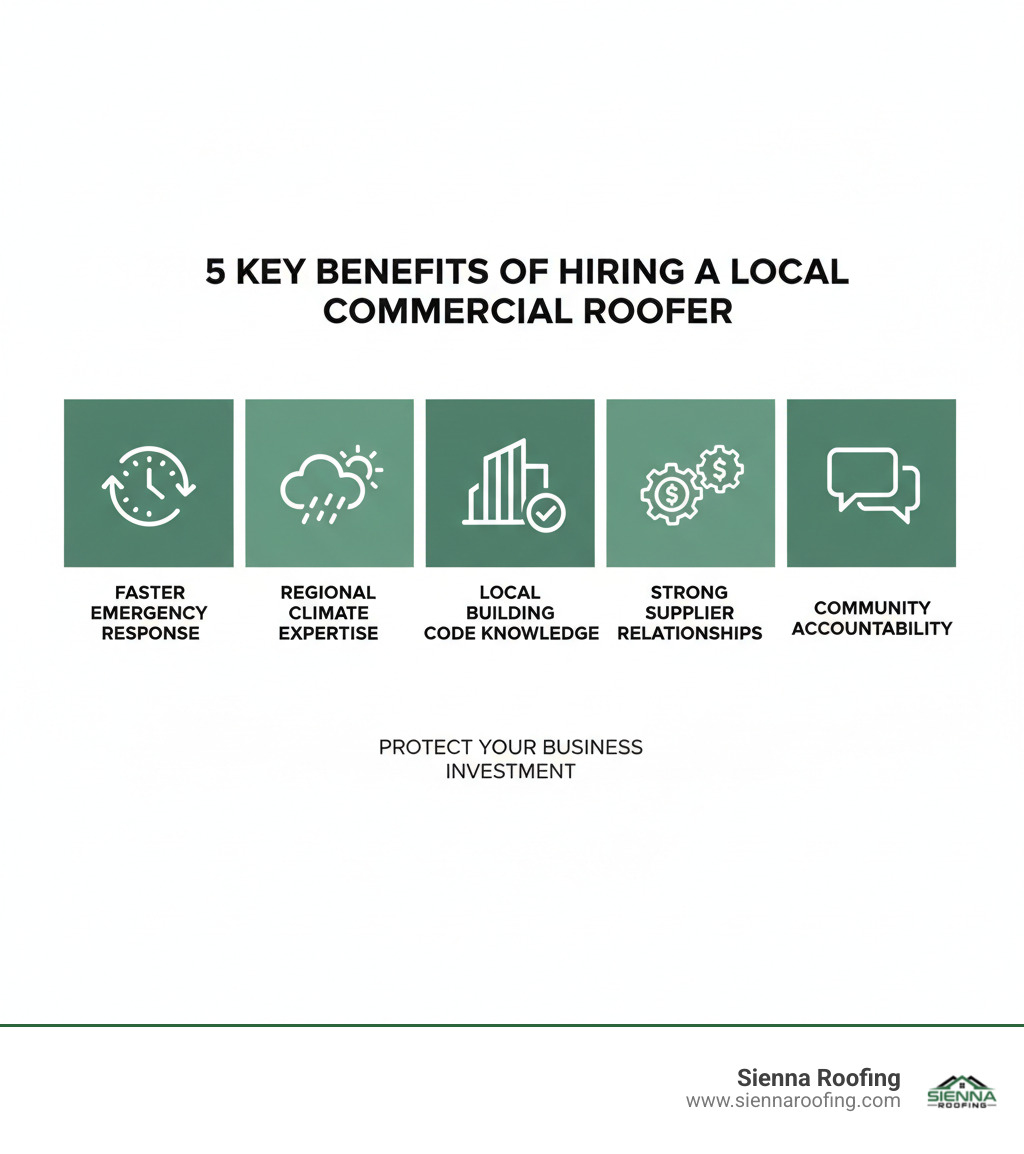
Benefits of Hiring a Local Commercial Roofer: (1) Faster Emergency Response, (2) Regional Climate Expertise, (3) Local Building Code Knowledge, (4) Strong Supplier Relationships, (5) Community Accountability.
The Local Advantage: Why Proximity Matters for Your Commercial Roof
Choosing a local commercial roofer is a strategic business decision that provides a level of accountability, responsiveness, and specialized knowledge that national chains and out-of-town contractors often cannot match. The success and longevity of local contractors are woven into the fabric of the community they serve. Their reputation isn’t just a star rating; it’s built on visible projects, word-of-mouth referrals from fellow business owners, and a powerful incentive to deliver exceptional quality and service every time.
Expertise in Regional Climate and Building Codes
A local commercial roofer possesses an indispensable, firsthand understanding of the region’s specific environmental challenges. The Houston climate is a formidable adversary for any roofing system. It’s a relentless combination of intense, year-round UV exposure that accelerates material degradation; extreme humidity that can trap moisture and promote mold growth; and the ever-present threat of hurricanes, which bring torrential rains and catastrophic wind uplift forces. Local experts don’t just know about these issues; they have spent years installing systems designed to combat them. They know precisely which materials, like highly reflective TPO membranes, perform best under prolonged sun and how to engineer robust drainage solutions that can handle the deluge of a tropical storm. This expertise extends to navigating the complex and often confusing web of municipal building codes, which can vary significantly between neighboring cities like Sugar Land, Missouri City, and Stafford. A seasoned local contractor is already familiar with specific requirements for wind uplift resistance (often guided by ASCE 7 standards), insulation R-values, and fire ratings. This familiarity streamlines the permitting process, prevents costly compliance failures, and ensures your project passes inspection without delays. For more insights into navigating local requirements, explore our resources on roofing companies in Sugar Land TX.
Faster Response Times for Emergencies and Repairs
When a roof leak appears over your production floor or in your retail space, every hour of delay can lead to thousands of dollars in damaged inventory, operational downtime, and escalating structural repair costs. The primary, undeniable advantage of a local commercial roofer is proximity. Imagine a severe thunderstorm damages your roof on a Friday afternoon. A local team can be on-site within hours to assess the damage, apply temporary tarping or patches to stop the bleeding, and schedule permanent repairs. In contrast, a national company may take days to dispatch a crew from a distant regional hub, leaving your property vulnerable. This rapid response has a direct and significant financial benefit. While typical commercial roof repairs cost between $380 and $1,800, a small leak left unaddressed for a weekend can quickly saturate insulation, compromise the roof deck, and lead to interior water damage, turning a simple fix into a major crisis. For instance, a basic gutter and downspout repair might cost $180 to $560, but if the resulting overflow is allowed to saturate the roof edge and compromise the underlying wood or metal deck, the repair costs could soar to $7,000 or more. Swift, decisive action from a local roofer contains the problem, controls costs, and gets your business back to normal faster.
Investing in Your Community and Economy
Hiring a local commercial roofer is an investment that strengthens the very community your business operates in. The money you spend on your roofing project doesn’t get funneled to a corporate headquarters in another state. Instead, it circulates back into the local economy. It pays the wages of local craftspeople who, in turn, spend their money at other local businesses—restaurants, shops, and service providers. Local roofing companies also prioritize building strong, long-term partnerships with area suppliers and distributors. This not only supports other local enterprises but can also translate into benefits for you, the client, through better material pricing and priority access during busy periods. Beyond the direct economic impact, local contractors have a vested, personal interest in the community’s well-being and aesthetic. Their reputation is built on the quality of work visible on buildings throughout the area. This shared commitment to the community’s prosperity translates into higher quality work, greater accountability, and a genuine sense of pride in every project they complete.
Your Vetting Checklist: How to Identify a Top-Tier Local Commercial Roofer
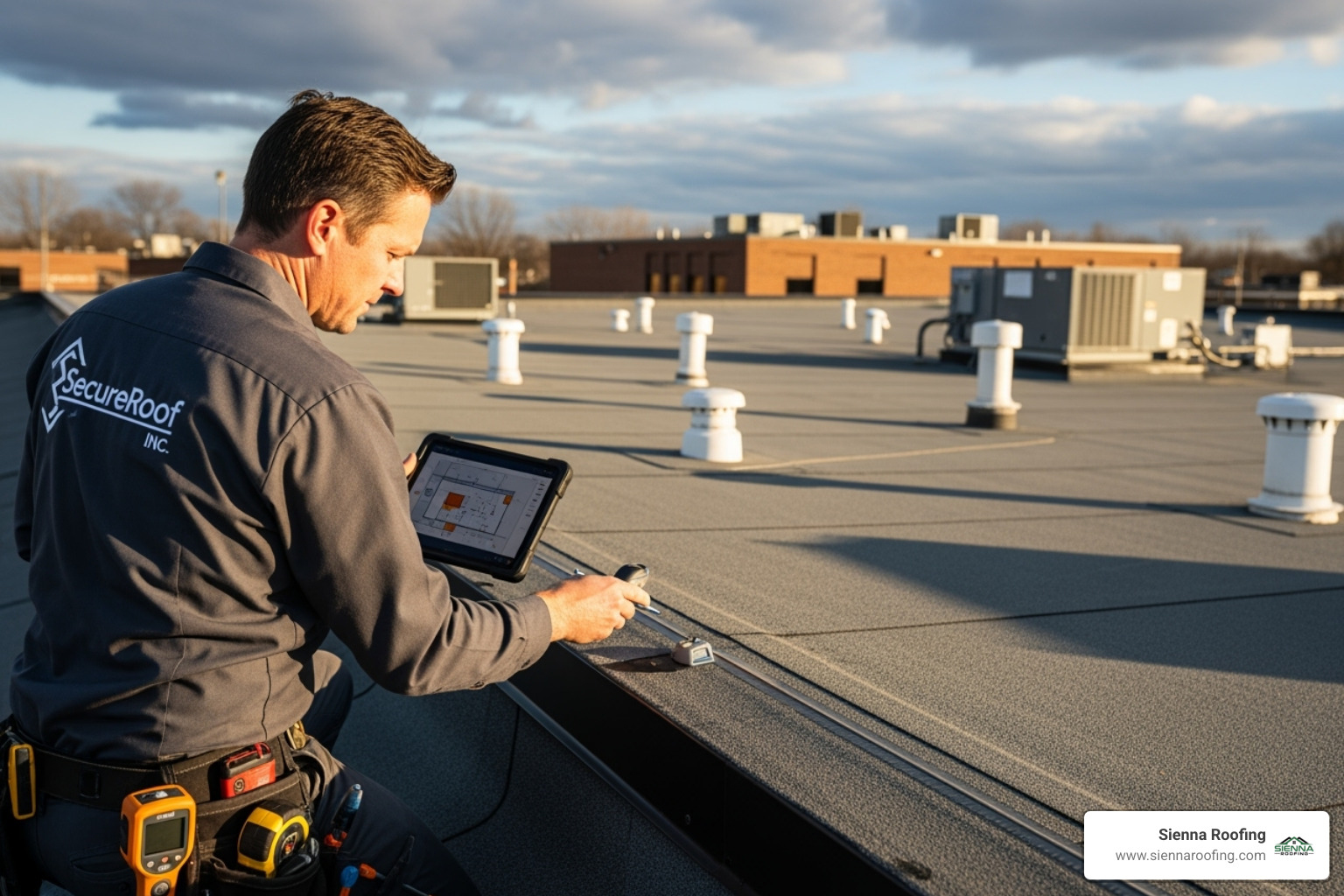
A uniformed roofing professional carefully inspecting a flat commercial roof with inspection tools.
Selecting the right local commercial roofer is a systematic process of due diligence, not a game of chance. A thorough vetting process is your best defense against contractors who deliver shoddy work, employ unsafe practices, or surprise you with hidden fees. By following a few essential checkpoints, you can confidently filter out the amateurs and identify a true professional who will protect your investment.
Verify Credentials, Insurance, and Experience
The first step is to verify a contractor’s qualifications with documentary proof. Do not just take their word for it; ask for copies of these critical documents.
- Licensing: Confirm the contractor holds all necessary state and local licenses required to perform commercial roofing work in your municipality. This is the baseline indicator of legitimacy and professional competence.
- Insurance: This is absolutely non-negotiable. The contractor must carry two key types of insurance. First is general liability insurance, which protects your property from damage caused by the contractor’s work. For a commercial project, look for a policy with a per-occurrence limit of at least $1,000,000 and a general aggregate limit of $2,000,000. Second is worker’s compensation insurance, which covers their employees in case of injury on your property and shields you from devastating liability lawsuits. Always request current insurance certificates and call the provider to verify that the policies are active.
- Manufacturer Certifications: Top-tier roofers earn certifications from major manufacturers like GAF, Carlisle, Firestone, or Johns Manville. These credentials—often with names like “Master Elite” or “President’s Club”—are not easily obtained. They signify that a roofer has undergone extensive factory training, has a proven history of high-quality installations, and is authorized to offer the manufacturer’s best warranties, which often cover both labor and materials. To understand why this is critical, you can learn more about contractor certification and its benefits.
- Experience & Portfolio: Ask to see a portfolio of completed commercial projects. Pay special attention to jobs that are similar in scope, material, and complexity to yours. Request references from recent commercial clients and actually call them to ask about their experience with the contractor’s communication, project management, and the performance of the finished roof.
Check Online Reviews and Local Reputation
A contractor’s reputation is a powerful, publicly available record of their reliability and quality. Start by seeking word-of-mouth recommendations from other local business owners, property managers, or facility engineers in your network. Their firsthand experiences can provide invaluable and candid insights.
Next, conduct a thorough investigation of online reviews on platforms like Google, Yelp, and the Better Business Bureau. Look beyond the overall star rating. Read the detailed comments to identify patterns. Consistent praise for professionalism, clear communication, on-site cleanliness, and sticking to the timeline are excellent signs. Also, pay close attention to how the contractor responds to negative feedback. A professional, constructive response that seeks to resolve the issue demonstrates accountability and customer commitment. A strong local reputation is earned through years of consistent excellence, making it one of your most reliable vetting tools.
Demand Detailed Estimates and Strong Warranties
An estimate and a warranty are your primary forms of financial and legal protection. A professional local commercial roofer will provide both with complete transparency and detail.
Your estimate should be a multi-page, itemized document, not a one-line price on a handshake. It should clearly break down the full project scope and all associated costs, including: materials (specifying brand, type, and quantity), labor costs, fees for permits, costs for tear-off and disposal of the old roof, and allowances for potential structural repairs (like replacing rotted decking). This level of detail allows for an accurate, apples-to-apples comparison between bids and prevents surprise charges. Be wary of any estimate that is unusually low or vague—it’s often a red flag for cut corners or future upcharges.
Your project should be protected by two distinct types of warranties, both provided in writing. The workmanship warranty (or contractor’s warranty) covers the quality of the installation and is provided directly by the roofer. The manufacturer warranty covers the roofing materials against defects. As mentioned, certified contractors can offer superior, integrated warranties that cover both labor and materials for extended periods (e.g., 20-30 years). Ensure you understand the terms, conditions, and exclusions of both warranties before signing any contract.
Core Services: What to Expect from a Full-Service Commercial Roofing Contractor
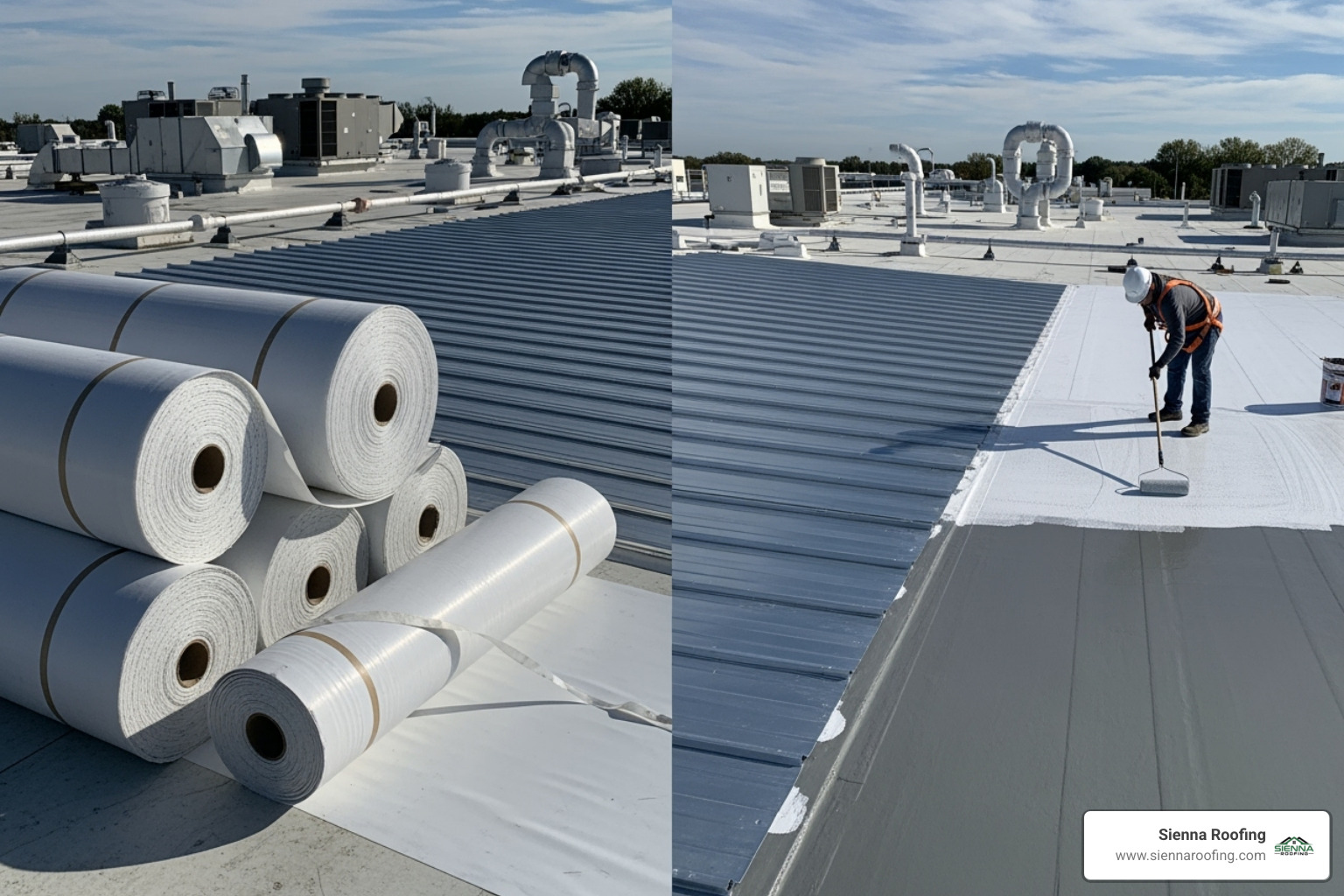
Different commercial roofing materials, such as TPO rolls, metal panels, and roof coating being applied.
A qualified local commercial roofer operates as a long-term asset management partner, offering a comprehensive suite of services designed to manage your roof’s entire lifecycle. This holistic approach is not only more convenient but also more financially prudent. Having a single, trusted contractor who knows your roof’s history, materials, and quirks can lead to more effective diagnostics, efficient repairs, and strategic long-term planning, ultimately maximizing the return on your initial investment.
Roof Inspections and Preventative Maintenance
Preventative maintenance is, without question, the most cost-effective strategy for maximizing your roof’s lifespan and preventing disruptive failures. Most major roofing catastrophes begin as minor, unnoticed issues like a small puncture, a clogged drain, or a cracked seam. Scheduled inspections, typically recommended semi-annually (especially before and after Houston’s storm season), allow professionals to identify and rectify these problems while they are small and inexpensive to fix. A comprehensive maintenance plan should include a detailed checklist of tasks, such as:
- Clearing the roof surface of all debris (leaves, branches, trash) that can trap moisture and clog drainage systems.
- Inspecting all drains, scuppers, and gutters to ensure they are clear and functioning properly to prevent water pooling (ponding).
- Examining all seams, flashing, and penetration points (around HVAC units, vents, and skylights) for signs of separation, cracking, or deterioration.
- Checking the membrane surface for punctures, blisters, or excessive wear.
- Performing minor on-the-spot repairs like sealing small cracks or re-securing loose flashing.
This proactive care prevents small issues from escalating into catastrophic leaks and costly emergencies, extending the life of your roof by years.
Commercial Roof Repair and Replacement
Even with diligent maintenance, all roofs will eventually require repair or replacement. A full-service local commercial roofer is equipped to handle both with precision and expertise. For repairs, accurate diagnosis is paramount. Experts in leak detection utilize advanced techniques, such as infrared thermography which reveals moisture trapped beneath the roof surface, to trace water intrusion to its precise source, saving you money on guesswork and ineffective patches. They are adept at handling everything from simple puncture and flashing repairs to comprehensive storm damage restoration. In the aftermath of a hurricane or severe storm, a reputable local roofer will act as your advocate, working directly with your insurance adjuster to ensure the scope of damage is fully documented and that your claim covers all necessary work. For guidance on building stronger against storms, resources from FEMA on hurricane-resistant practices can be invaluable. When repairs are no longer a cost-effective option, a full replacement is the next logical step. A professional contractor will guide you through the entire process—from material selection and budgeting to final inspection—all while creating a phasing plan that minimizes disruption to your daily business operations. You can explore the full range of solutions we offer by viewing our Commercial Roofing Services.
Installation of Modern Roofing Systems
The commercial roofing industry offers a diverse array of advanced systems, each with unique benefits. A versatile contractor should be proficient in multiple options to recommend the best fit for your specific property, budget, and performance goals.
- TPO and EPDM: These single-ply membrane systems are the dominant choice for modern flat and low-slope roofs. TPO (Thermoplastic Olefin) is prized for its white, highly reflective surface that reduces cooling costs, and its seams are hot-air welded for a monolithic, durable bond. EPDM (Ethylene Propylene Diene Monomer), a synthetic rubber, is known for its exceptional durability, flexibility, and resistance to weathering and hail.
- Metal Roofing: Offering unparalleled longevity of 40-60+ years, metal roofing is a wise long-term investment. Systems like standing seam metal are resistant to fire, wind, and impact. They are available in various materials (steel, aluminum) and colors, offering both superior protection and a high-end aesthetic.
- Flat Roof Systems (Modified Bitumen & BUR): Traditional multi-ply systems like Modified Bitumen (Mod-Bit) and Built-Up Roofing (BUR) offer robust, redundant waterproofing. Mod-Bit combines asphalt with rubber modifiers for enhanced flexibility and is applied in layers, often with a granular surface for UV protection. BUR systems consist of multiple layers of asphalt and reinforcing fabrics, creating a thick, durable, and time-tested roof.
- Roof Coatings: Liquid-applied elastomeric coatings can be a cost-effective solution to extend the life of an existing roof. These seamless membranes (often silicone, acrylic, or polyurethane) are applied over the current roof, sealing minor cracks and imperfections, improving energy efficiency with a reflective topcoat, and renewing the roof’s waterproofing capabilities.
Local Experts vs. National Chains: A Head-to-Head Comparison
When choosing a roofing contractor for your commercial property, you’re often faced with a fundamental choice: partner with a local specialist or hire a large, national corporation. While both can technically perform the work, a local commercial roofer offers distinct, tangible advantages that align directly with the needs of business owners who value accountability, responsiveness, and customized expertise.
The following table provides a direct, at-a-glance comparison of the key differences you can expect:
| Feature | Local Commercial Roofer | National Roofing Company |
|---|---|---|
| Response Time | Typically faster, especially for emergencies | Can be slower due to larger service areas and corporate dispatch |
| Accountability | High; reputation is tied to the local community | Lower; often use subcontractors, less direct accountability |
| Local Knowledge | Excellent; deep understanding of local codes & climate | General; may lack nuanced understanding of micro-climates |
| Service | Personalized, direct contact with owner/project manager | Standardized, may involve multiple points of contact |
| Pricing | Competitive; lower overhead | Can be higher due to corporate overhead and marketing costs |

Comparison: Local vs. National Roofers. Local: Faster Response, High Accountability, Excellent Local Knowledge, Personalized Service, Competitive Pricing. National: Slower Response, Lower Accountability (subcontractors), General Local Knowledge, Standardized Service, Higher Pricing (corporate overhead).
Response Time & Accountability: A local roofer’s proximity is their superpower, allowing for a rapid emergency response that minimizes water damage and operational downtime. Their reputation is their most valuable asset, built one project at a time within the community. This creates a powerful, built-in incentive for high-quality work and direct accountability. When you have an issue, you’re often speaking directly with a decision-maker or the owner, not navigating a call center or dealing with a subcontractor who has no direct relationship with you.
Local Knowledge & Personalized Service: Local experts possess an ingrained, practical understanding of regional climate challenges and the intricate details of municipal codes, ensuring your roof is not only compliant but truly built to last in its environment. This expertise translates into personalized service. A local project manager can tailor the work schedule to minimize disruption to your specific business operations, whereas a national chain often imposes a rigid, one-size-fits-all process. They provide custom solutions, not just a catalog of standard options.
Pricing & Subcontractors: With significantly lower overhead costs compared to large national corporations (which have to fund corporate offices, national marketing campaigns, and multiple layers of management), local roofers can often provide more competitive and transparent pricing. Their bids reflect the true cost and value of the work, not inflated administrative fees. Furthermore, many national companies rely heavily on a rotating cast of local subcontractors. This can create a disconnect in quality control and accountability. If a problem arises, you may find yourself caught between the national brand and the subcontractor, with each pointing fingers at the other. A local roofer uses their own trained, trusted crews, ensuring consistency and a single point of responsibility.
Frequently Asked Questions about Hiring a Local Roofer
Choosing a local commercial roofer is a significant decision, and it naturally brings up important questions. To help you navigate the process with confidence, here are clear, concise answers to some of the most common inquiries we receive from Houston-area business owners.
What is the difference between a local commercial roofer and a residential one?
The primary difference lies in deep specialization. A local commercial roofer is an expert in the distinct materials, complex techniques, and stringent safety standards specific to large-scale business properties, which typically feature flat or low-slope roofs. They are proficient with systems like TPO, EPDM, Modified Bitumen, and standing seam metal, which require specialized equipment and installation methods vastly different from the asphalt shingles used in most residential roofing. Furthermore, commercial projects involve navigating complex drainage systems, numerous rooftop equipment penetrations (HVAC, plumbing vents, etc.), fire rating requirements, and far more stringent building codes related to wind uplift and energy efficiency. A residential roofer typically does not possess the equipment, training, or insurance coverage to properly and safely handle these demands.
How much does a commercial roof repair cost?
The cost of a commercial roof repair varies widely based on the problem, but industry averages place typical minor repairs between $380 and $1,800. This range would cover issues like sealing a few open seams, patching a small puncture, or repairing a piece of damaged flashing. However, costs can increase significantly with the extent and complexity of the damage. For example, repairing a sagging roof section caused by ponding water could cost between $1,500 and $7,000 or more, as it may involve structural work to the roof deck. The final price depends on the size of the repair area, roof accessibility, and the specific type of roofing system. Always obtain a detailed, itemized estimate before authorizing any work.
Can a local contractor handle a large commercial project?
Absolutely. Many established local commercial roofers are fully equipped and staffed to manage large-scale projects for warehouses, manufacturing plants, retail centers, and industrial facilities. These reputable local companies build their entire business model on successfully completing major projects. They maintain strong, long-standing relationships with material suppliers to ensure timely access to large quantities of products and employ large, highly trained crews with the specialized equipment needed for complex installations. When vetting a local contractor for a large project, perform your due diligence: ask to see a portfolio of previous commercial work of a similar scale, request client references for those projects, and verify that their insurance coverage and bonding capacity are adequate for the total value and scope of your job.
How long does a commercial roof last?
The lifespan of a commercial roof depends heavily on the material, the quality of the installation, the local climate, and the consistency of preventative maintenance. Here are some general estimates:
- TPO & PVC: 15 to 30 years
- EPDM (Rubber): 20 to 35 years
- Metal Roofing: 40 to 60+ years
- Modified Bitumen & BUR: 15 to 25 years
- Spray Foam & Coatings: 10 to 20 years (can be extended with recoating)
Regular maintenance is the key to achieving or exceeding these lifespans.
What is the best type of roof for a commercial building in Houston?
There is no single “best” roof; the ideal choice depends on your building’s use, roof slope, budget, and energy efficiency goals. However, for the hot, sunny Houston climate, a white TPO roof is often an excellent recommendation. Its highly reflective surface can significantly reduce a building’s cooling costs. For businesses prioritizing maximum longevity and durability against hail and wind, a standing seam metal roof is a superior long-term investment. For roofs with heavy foot traffic or numerous penetrations, a robust multi-ply system like Modified Bitumen can be a great choice.
How can I tell if my commercial roof needs to be replaced or just repaired?
This is a critical question. You should consider replacement if you observe: widespread and recurring leaks, extensive blistering, cracking, or shrinkage of the roof membrane across more than 25% of the roof surface, significant water damage to the insulation or roof deck, or if the roof is well past its expected service life. If the cost of necessary repairs approaches 30-50% of the cost of a full replacement, replacement is the more financially sound option. Repairs are more appropriate for localized issues like isolated leaks, minor punctures, damaged flashing around a single penetration, or problems confined to a small, well-defined area.
Conclusion: Secure Your Business with a Trusted Local Partner
Your commercial roof is one of the most vital components of your business infrastructure, a silent guardian protecting your physical assets, your dedicated employees, and your day-to-day operations from the elements. Choosing the right local commercial roofer is therefore not an expense, but a strategic investment in your company’s security, stability, and long-term longevity. It is about forging a partnership with a contractor who intimately understands our region’s unique and demanding climate, navigates complex building codes with ease, responds with urgency when emergencies strike, and operates with a level of accountability that only a community-based business can truly offer.
As we’ve covered, a diligent and thorough vetting process—one that includes verifying credentials and insurance, scrutinizing local reputations, and demanding complete transparency in estimates and warranties—is essential to making a wise choice. A full-service local partner will move beyond a single transaction to offer proactive preventative maintenance, expert repairs, and proficiency in a wide range of modern roofing systems, ensuring your investment is managed and protected for years to come. The clear advantages of a local expert in responsiveness, accountability, and specialized knowledge consistently deliver superior, lasting value over the standardized and often impersonal approach of national chains.
When you hire a local commercial roofer, you’re not just buying a service; you’re building a relationship with a neighbor and investing back into the economic health of the community where you do business. For Houston-area businesses in Sugar Land, Missouri City, Richmond, and beyond who are seeking a partner with this unwavering commitment, Sienna Roofing is here to help. We are dedicated to delivering premier roofing and solar solutions that protect your business for decades.
Ready to secure your business with a trusted local partner who understands your needs? Schedule your free, no-obligation estimate online today. Our consultation includes a comprehensive roof assessment, a transparent quote with clear options, and a strategic plan to protect everything you’ve worked so hard to achieve.